Page:The Strand Magazine (Volume 5).djvu/463
thankful for it. He preferred a donkey's ears to the sheep's, so had them substituted. Even then, some mistrust of the boldness of the design intimidated him, and he cautiously compromised by having them small. The only part of a kangaroo or wallaby that has the least independence about it is the tail; and the wallabies are so proud of the individuality, that they sit with their tails extended before them all day: and the colonist acknowledges the merit of the kangaroo's tail by making soup of it. Let us grant the kangaroo his tail, since it is the only thing that is unmistakably his own. Abashed at his own temerity in venturing to take an independent tail, all the kangaroo's other selections became hopelessly demoralized. He took a grasshopper's hind legs, and plagiarized a rat's fore-paws. Obviously, he got the design of his coat partly from the rabbit and partly from the rat, and the idea of his pouch from the bookmaker.
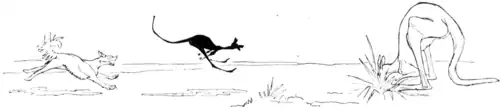
The wicked dingo dog; or

innocence
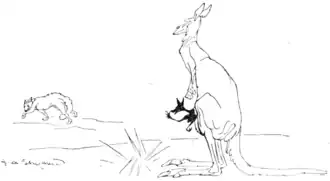
preserved.
Now, it is a noticeable thing, illustrative of the mental stagnation of the kangaroo, that, having adopted the crude idea of the bookmaker's or 'bus-conductor's pouch, he—or, rather, she—through all the generations, has never developed an improvement on that pouch, either by evolution, selection, or natural adaptation. Even in these days of improvement, the kangaroo's pouch has no separate compartment for silver. Of course it is mainly used to carry the family in, but in any really intelligent and enterprising class of animals that pouch would long ago have improved and developed, through the countless ages, into a convenient perambulator, with rubber tires and a leather hood. As it is, the kangaroo has not so much as added a patent clasp.
Still, in its merely primitive form, the pouch is found useful by the small kangaroo. It is an ever-ready refuge from the prowling dingo dog, and any little kangaroo who breaks a window has always a capital hiding-place handy. Indeed, the young kangaroo would fare ill without this retreat, because any other cradle the mother, being a kangaroo, would probably forget all about, and lose. It is only because the pouch hangs under her very nose that she remembers she has a family at all. All the kangaroo's strength seems to have settled down into the hind legs and the tail, leaving the other parts comparatively weak, and the head superlatively useless, except as an attachment for the mouth. One would imagine that in the period which has elapsed since the Creation the feeblest-minded of animals would have had time to arrive at some final choice in the matter of coat-colour; but the kangaroo hasn't. He never makes up his mind about anything; he begins life in a pale-grey colour; in a year or two he changes his mind and turns very dark—darker than either his father or his mother. The originality pleases him for a little while, and then he gets doubtful of his choice, and makes a wretched compromise—the kangaroo is a compromise all over—settling