Page:The Strand Magazine (Volume 5).djvu/366
loose change, in my pocketless costume, he spread out my handkerchief, and putting my money and the small things from my pockets into it, knotted it securely up and thrust it into my breast. Then, as we stood facing cach other, he took my hand in farewell. I proposed our goirg on together, but this he would not hear of.
"No," he said, with his grim laugh, "the sooner I and that suit of clothes part company, the better!"
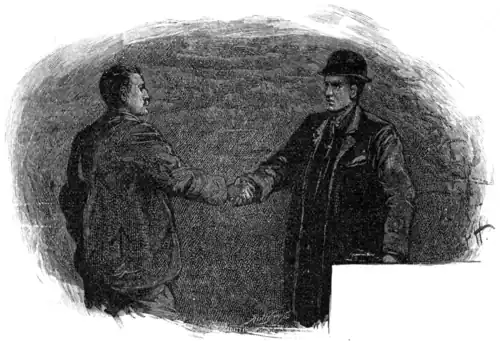
"We wished each other god-speed."
So we wished each other God-speed, and turned on our different ways—he going back through the tunnel, and I keeping on.
The experiences of the last few hours had made a great impression on me, and, although I felt awed and somewhat shaken, my heart was light with the gladness of onc who rejoices in a reprieve. The express that I had been so anxious to catch had long since gone on its way; still, in my present hopeful frame of mind, that did not trouble me. I felt a conviction that Mary was mending, that I should find her better, and, comforted by this belief, I walked briskly on; at least, as briskly as my clumsy shoes would allow me, but even in spite of this hindrance, it was not long before I reached the end of the tunnel. The moonlight streaming down upon the rails was a pleasant sight, and showed me, some time before I reached it, that my goal was at hand. When I left the last shadow behind me and stood out under the clear sky I drew a sigh of intense thankfulness, drinking in the sweet fresh air.
I walked down the country road, thinking that I would rest for a few hours at the station hotel and be ready for the first train in the morning. But my adventures were not yet over. As I glanced at my clothes, thinking how unlike myself I looked and felt, something on the sleeve of my coat attracted. my attention; it must be tar, which I or the former wearer of the clothes must have rubbed off in the tunncel. But, no. I looked again—my eyes seemed riveted to it. It was unmistakable. There, on the coarse grey material of the coat, was a large broad-arrow.
In an instant the whole truth had flashed upon me. No need to examine those worsted stockings and heavy shoes—no need to take off the coat and find upon the collar the name of one of Her Majesty's prisons, and the poor convict's number. As my eyes rested on the broad-arrow I understood it all.
At first I was very indignant at the position I was in. I felt that a trick had been practised upon me, and I naturally resented it. I sat down by the roadside and tricd to think. The cool air blew in my face and refreshed me. I had no hat; the convict—I was beginning to think of him by that name—had given me none, saying he had lost his cap in the tunnel. After a while, when my anger had somewhat subsided, I thought more pitifully of the man whose clothes I wore. Poor wretch, without doubt he had had a hard time of it; what wonder that he had seized upon the first opportunity of escape. He had said that the favour he required would entail personal inconvenience on myself, and that was exactly what it did. I looked at the matter from all sides; I saw the dilemma I was in. It would not do to be seen in this branded garb—the police would lay hands on me at once; nothing would persuade them that I was not the convict. Indeed, who was likely to believe the improbable story I had to tell? I felt that I could expect few to credit it on my mere word, and I had nothing to prove my identity, for I remembered now that my pocket-book and letters were in my coat; I had