Page:The Strand Magazine (Volume 5).djvu/356
tion of the costume of the period; and I was shown a curious old print of Tonbridge in the time when the well-to-do farmers wore top-hats and swallow-tailed coats, in which the vane is represented just as it appears at present. Vane number two is a much weathered and discoloured one, almost within touch, on a wooden turret surmounting the Town Hall—a typical Georgian building, lately threatened with demolition, and for the further life of which I noted a vigorous pleading in the pages of The Graphic of November 4th, 1892. Number three is a fox, rudely cut out of flat metal, with a "ryghte bushie tayle," fixed on a house gable overlooking the street.


The Orlestone sketch represents a type of vane practically never to be met with, save on the oast-houses in the hop-growing districts of Kent. The particular one noted stands at the bottom of a garden belonging to an Elizabethan timbered house hard by the church. It will be remarked that the animal, which is about 2ft. long, is very crude in shape; it represents a fox, and the obvious way Mr. Reynard's tail is joined on is very enjoyable.
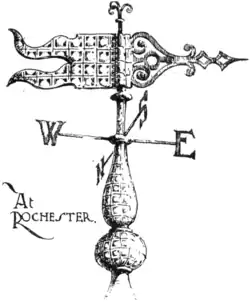
Rochester admittedly possesses one of the finest vanes to be found all England over; it is in the main street on the Town Hall