Page:The Strand Magazine (Volume 5).djvu/349

The picturesque quality and almost almost endless variety of vanes―from the modest arrow to the richly-gilt and imposing heraldic monster―which meet the eye as one wanders through quiet village, busy market town, or sleepy cathedral city, and the traditions which are associated with these distinctly useful, time-honoured, and much consulted adjuncts to church or home, make me hope that the following brief notes and sketches of a few of the many types one sees may not be without interest to some of the numerous readers of The Strand Magazine.
That eminent authority on things architectural―the late John Henry Parker, F.S.A.—tells us that vanes were in use in the time of the Saxons, and in after ages were very extensively employed, there being notable development during the prevalence of the Perpendicular and Elizabethan styles.
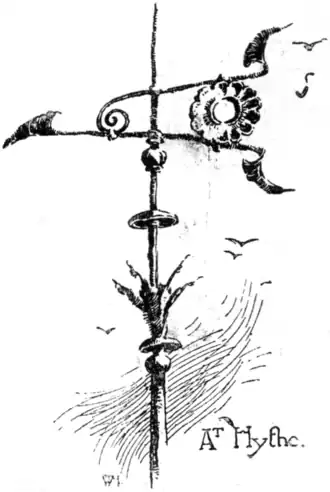
To anyone vane-hunting―or health-hunting, for the matter of that―I would recommend them to tramp, sketch or note book in hand, over that stretch of country which occupies the most southerly corner of Kent, known as Romney Marsh; and beginning, say, at Hythe―one of the old Cinque Ports, and still a place of considerable importance―they will there find several vanes worthy of note, specially perhaps the one which surmounts the Town Hall, in the High Street. It is in excellent condition, and is contemporary with the building itself, which was erected in 1794.
The country between Hythe and Dymchurch has quite a plethora of rustic vanes―