Page:The Strand Magazine (Volume 5).djvu/336
the resting-place of the third Royal son. No costly sepulchre, but a simple grassy mound, surrounded by gilt iron railings with a plain headstone, recording the name and date of birth and death of the infant Prince, and the words "Suffer little children to come unto Me" added.
The church itself is of ancient date, and has been twice restored and enlarged by the Prince. It has a font of early times, and some half-dozen stained glass windows. The Prince has caused several monuments, busts, etc., to be placed there, conspicuous being busts to the late Princess Alice and the Emperor Frederick, a medallion to the late Duke of Albany, a stained glass window to the infant Prince, and monuments to the Revs. W. L. Onslow and G. Browne. The most noticeable of anything there, how ever, is a very handsome brass lectern, placed by the Princess as a thank-offering for the recovery of the Prince from his dangerous illness of typhoid fever. The event is within the memory of most of us, and needs only a brief notice to recall the national anxiety that was displayed on the occasion. The lectern bears the following inscription: "To the glory of God. A thank-offering for His mercy, 14th December, 1871. 'When I was in trouble, I called upon the Lord, and He heard me.'"
The space for worshippers is limited, and is generally quite filled by the household. The Royal Family occupy carved oak seats in the nave. The organ is a very fine one, particularly sweet in tone, and is situated in the rear of the building; it is presided over by a very able musician, who is also responsible for the choir—this consisting of school children, grooms, gardeners, etc. The singing is really good.
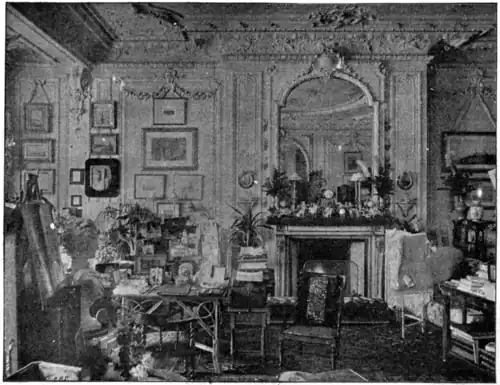
The Princess of Wales' Boudoir.
From a Photo. by Bedford Lemere.
I have heard down there of a former organist, who was not a great musician, and, in fact, was more at home in the village shop, of which he was proprietor. Sunday after Sunday he made the most awful mistakes, and, in consequence, was continually warned of his probable dismissal. The Princess, with her invariable kindness, had been the cause of his staying so long as he had; but one Sunday the climax was reached and the Royal patience fairly exhausted. Mr. Gladstone (then in office) was on a visit, and his solemn, grim countenance as he