Page:The Strand Magazine (Volume 5).djvu/294
Hands.
By Beckles Willson.
II.
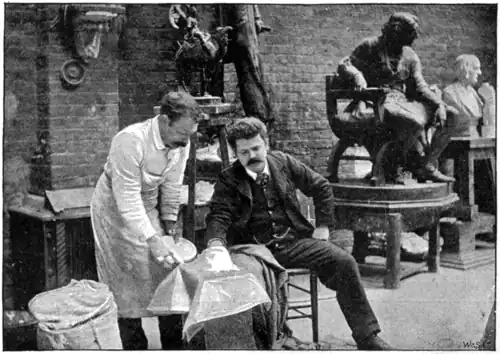
Casting a hand from life.
(Studio of Mr. Onslow Ford, A.R.A.)
 he sculptor's practice of casting plaster the hands of his client is of comparatively recent growth. The artist of the old school—and he is followed in this by many of the new—disdained so mechanical a means to fidelity. Very few, indeed, among the British painters and sculptors of the past will be found who took the pains to see that the hands or even the figures of their counterfeit presentments on canvas or in marble tallied with the originals. Sir Joshua Reynolds, as we know, would have regarded this as the essence of finical vulgarity.

Thomas Carlyle's hands.
The principal drawback in making casts from life is to be found in the discomfort, not to speak of the actual torment, it often causes the sitter by the adhesion of the plaster to the hairy growth of the skin. Various methods are resorted to with a view to obviate this, and in some cases successfully.
The hands of Thomas Carlyle—stubborn, combative, mystical—which appear in the present paper, will amply repay the closest scrutiny. These hands are unwontedly realistic, and emphasize their distinctiveness in every vein and wrinkle. They appear to be themselves endowed with each of those various qualities which caused their possessor to be regarded as one of the most puissant figures in the century's literature. The hand is not one, to use Charles Lamb's expressive phrase, to be looked at standing on one leg. It deserves a keener examination.
Mention has been made of the hand of a distinguished prelate, Cardinal Manning,