Page:The Strand Magazine (Volume 5).djvu/241
foremost; but all with his own flashing vividness, which makes me so sorry—so sorry whenever I think of it. At moments he would stand still before the chair on which I sat intent, and beat one hand upon the other, and look down at me with a grand, wondering smile, as though he himself could hardly believe what the gods had put into his head, or that the gift was real gold, it glittered so at first sight. On that point I could reassure him. My open jealousy made me admire soberly. But when he told me, quite suddenly, as though on an afterthought, that he meant to make a play of it and not a story, I had the solid satisfaction at that moment of calling him a fool.
"The ordinary author of my day, you see, had a certain timorous respect for the technique of the stage. It never occurred to us to make light of those literary conventions which it was not our business to understand. We were behind you fellows in every way. But Pharazyn was a sort of forerunner: he said that any intelligent person could write a play, if he wanted to, and provided he could write at all. He said his story was a born play; and it was, in a way; but I told him I doubted whether he could train it up with his own hand to be a good acting one. I knew I was right. He had neither the experience nor the innate constructive faculty, one or other of which is absolutely necessary for the writing of possible plays. I implored him to turn the thing into a good dramatic novel, and so make his mark at one blow. But no; the fatal fit was on him, and I saw that it must run its course. Already he could see and hear his audience laughing and crying, so he said, and I daresay he could also feel the crinkle of crisp weekly receipts. I only know that we sat up all night over it, arguing and smoking and drinking whisky until my windows overlooking the river caught the rising sun at an angle. Then I gave in. For poor old Pharazyn was more obstinate than ever, though he thanked me with the greatest good temper for my well-meant advice.
"'And look here, my boy,' says he, as he puts on his hat, 'you shan't hear another word about this till the play's written; and you are to ask no questions. Is that a bargain? Very well, then. When I've finished it—down to the very last touches-you shall come and sit up all night with me, and I'll read you every word. And by gad, old chap, if they give me a call the first night, and want a speech—and I see you sitting in your stall, like a blessed old fool as you are—by gad, sir, I'll hold up you and your judgment to the ridicule of the house, so help me never!'
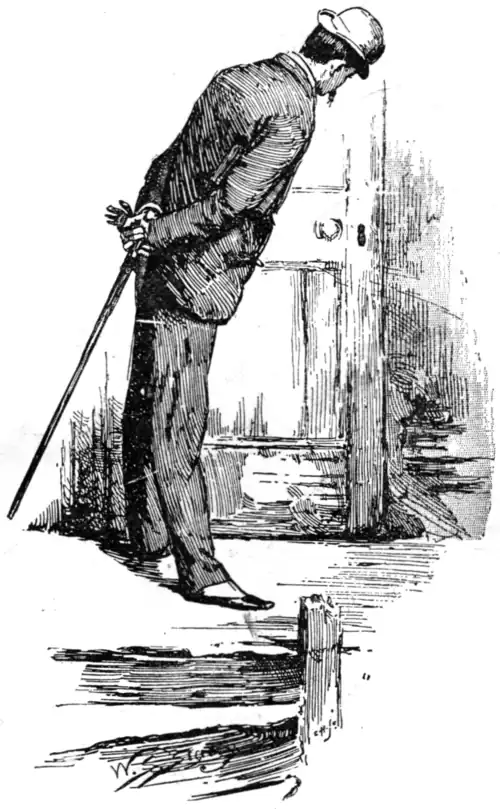
"I could smell his pipe through the keyhole."
"Well, I am coming to that first night presently. Meanwhile, for the next six months, I saw very little of Pharazyn, and less still in the new year. He seldom came to my rooms now; when he did I could never get him to stay and sit up with me; and once when I climbed up to his garret (it was literally that), he would not answer me, though I could smell his pipe through the key-hole, in which he had turned the key. Yet he was perfectly friendly whenever we did meet. He said he was working very hard, and indeed I could imagine it; his personal appearance, which he had never cherished, being even untidier, and I am obliged to add seedier, than of old. He continued to send me odd magazines in which his stuff happened to appear, or occasionally a proof for one's opinion and suggestions; we had done this to each other all along; but either I did not think about it, or somehow he led me to suppose that his things were more or less hot from the pen, whereas many of mine had been written a twelvemonth before one saw them in type. One way or another, I gathered that he was at