Page:The Journal of geology (IA journalofgeology21894univers).pdf/370
Then, denoting the three elements by their initials:
;
; and
[1]


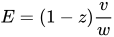
Obviously, these elements are of unlike value in different parts of the cross-section of a glacial valley, and the rate of erosion is hence differential; but since important unknown factors are involved, no reliable expression either for the absolute rate of erosion at any point, or for the ultimate form of the glacial bed, can be directly deduced. The general tendency of glacial action may, however, be learned from separate consideration of the individual tendencies of the several agencies comprehended.
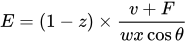
- ↑ In the above statement, it has been the purpose to eliminate what is thought to be an element of uncertainty in the extension of the customary formula for friction to quantities so great and so peculiarly conditioned as those involved in the movements of great glaciers. It might be simpler also, as Dr. Hendricks points out, to reduce the determinants of glacier motion to those of positive action—viz., (1), the weight of the ice, (2), the declivitiy of the channel, and (3), the potential energy available in producing mass motion—by excluding the negative determinant, friction. The down-stream impulse might also be represented by nw sinΘ, n being an unknown factor depending on molecular force, and hence involving temperature, etc. Then, making x the co-efficient of friction, the equations would become:
;
; and
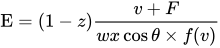
.Or, introducing the factor f (v) to represent the influence of velocity of flow in determining the friction; the last two equations would become:
; and
.It will be observed that this modification of the equations for intensity, friction, and efficiency do not materially affect the discussion, and do not in any way detract from the conclusions reached. The original equations are retained, however, in the opinion that they suggest, if they do not actually present, the more direct and serviceable mode of analysis.
It is a pleasure to acknowledge obligation to Dr. J. E. Hendricks, of Des Moines for working out the expressions in this note (January 25, 1885).