Page:The Journal of geology (IA journalofgeology21894univers).pdf/177
of the district toward the coast. Oscillation in the position of the shore line, and later denudation have occasioned, in many instances, a marked divergence from these normal conditions, so that detached areas are frequently found far removed from the body of the main outcrop.
The formations of the New Jersey coastal area and their economic equivalents are given in the following table:
| Age. | Formation. | Economic Equivalent. | |||||
|---|---|---|---|---|---|---|---|
| Pleistocene | Columbia Formation | ||||||
| Neocene | Lafayette | " | |||||
| Chesapeake | " | ||||||
| Eocene | Shark River | " | Upper Marl Bed | Greensand Series. | |||
| Cretaceous | Manasquan | " | |||||
| Rancocas | " | Middle Marl Bed | |||||
| Redbank | " | Red Sand | |||||
| Navesink | " | Lower Marl Bed | |||||
| Matawan | " | Clay Marls | |||||
| Raritan | " | Plastic Clay | |||||


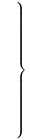

The greensands characterize all the deposits from the Matawan formation to and including the Shark River formation. The glauconite appears in varying amounts and under different conditions in these several formations, so that the lithologic features are often sufficiently distinctive and persistent to be of the greatest service in the determination of the horizons. The presence of greensand has not been observed in the Raritan formation which underlies, nor in the Chesapeake formation which overlies, this series of glauconitic deposits.
Matawan formation (Clay Marls).—On account of the extensive and typical development of the Clay Marls on the shore of the Raritan Bay in the vicinity of Matawan Creek, and along the banks of the latter stream, the name Matawan formation is proposed for the deposits of this horizon.
The greensand is a less pronounced feature than in the overlying formations. The deposits consist for the most part of dark colored clays with interbedded layers of sand, the latter becoming very pronounced in the upper portion of the formation. At some points beds of greensand appear, but they are generally