Page:The Green Bag (1889–1914), Volume 05.pdf/307
mother and educated himself. After receiving a common-school education, he entered the academical department of Cumberland University, and took his degree in 1871 . He graduated from the law department in 1872. While learning the lesson of law from Chancellor Green, he conned the lesson of love from the daughter. He was married on Oct. 22, 1874, to Miss Ella Green, daughter of Chancellor Green, and grand - daughter of Judge Nathan Green. Judge Caldwell practised at Trenton, Tenn., until 1883, when he was appointed a member of the Commission of Referees for the middle division of the State. He continued to serve until May, 1886, when the business before it was disposed of. He became a candidate for Supreme Judge, and was nominated on the first ballot by the convention, receiving on the call of the roll a larger vote than was cast for any other candidate.
He has served most acceptably as a judge, and has taken high rank. He has an immense capacity for labor, and is the master of details, being gifted with an unusually good memory. He can handle a complicated record better than any man on the bench. His opinions are always carefully prepared, and are never handed down until perfectly finished in every part. Judge Caldwell has the unusual faculty of exact statement. The doctrines meant to be enunciated are accurately given, and the position taken shown; and his opinions do not have to be continually limited and explained. There are two classes of questions in which he is particularly proficient, the law of common carriers and that of taxation; and many of his best opinions bear on these.
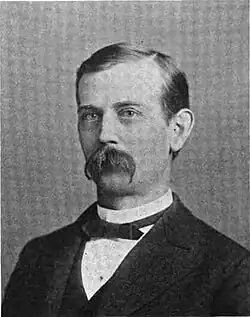
David L. Snodgrass was born at Sparta, Tenn., April 4, 1851. He was the son of Thomas Snodgrass, a lawyer practising at that bar. Having received an academic education in the schools of White County, he completed his education at the University of Tennessee at Knoxville. He read law under the tuition of his father, and was admitted to the bar in October, 1872. He practised his profession at Sparta for ten years, appearing in the various courts of that circuit. He was the member from White and Putnam Counties of the Lower House of the General Assembly of 1879. He was assigned to the three most important committees of that body, and became one of the leaders of his faction during that exciting session. The final trouble over the settlement of the State debt was then beginning. That Legislature passed an act for funding the debt at 50-4, and submitted it to the people for ratification. The proposition was rejected at the election, and this caused the trouble to commence anew. Judge Snodgrass was a delegate to the Democratic convention in 1880. That convention having adopted a platform on the debt question which the "Low Tax " delegates did not think in accord with the views of a majority of the party, the "Low Tax" delegates, headed by Judge Snodgrass, bolted the convention and