Page:The Czechoslovak Review, vol4, 1920.pdf/65
ganda came too late and is not doing the Magyars any good; and as to agitation among the former nationalities of Hungary, the Slovaks, Roumanians, Rusins and others are not as simple-minded, as Budapest takes them to be. In Roumania the present government is controlled by leaders of Roumanians from Transylvania, Rusins have their own government and the Slovaks point eloquently to the school record: one thousand years of Magyar rule did not produce one Slovak high school, while one year of Czechoslovak rule created over 40. Incidentally Slovak leaders in answer to invitation to join the Magyars in a happy union under one king draw a comparison between Slovakia and Magyaria in 1919. The proud rulers of Hungary looked on Slovaks as an inferior race, fit only to obey the lordly Magyar, the kinsman of the Turks and Tartars. In 1919 Hungary proper passed through three revolutions; a few months ago the reds were shooting the noblemen and priests, now the patriots hang the leaders of the workingmen and the Jews, while the country is bankrupt and Budapest starving. Slovakia is in comparison prosperous, public order has been steadily maintained and great progress made in the first year of independence. Magyars under their new king, whoever he may be, will be a disturbing element in Central Europe, but fortunately their country it too small—less than eight million people—to be a real danger to its neighbors.
Czechoslovak Information Bureau.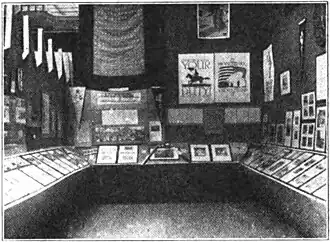
Service Flag of Cleveland Czechoslovaks, American Room, Exhibit of Legionaries. Czechoslovak Information Bureau.
Flags of Legionary Regiments Around Masaryk’s Bust.After five and a half years Czechoslovaks in Siberia are about to be sent home. At least this time there is a definite pledge on the part of the American and British governments to furnish the shipping and extend credit to the Czechoslovak government for the cost of transportation. Up to the present nearly ten thousand invalids and soldiers over 42 have been sent home through the efforts of the army itself; the leaders chartered Japanese freight boats, loaded them with raw materials needed in Bohemia and brought Czechoslovak manufacturers on the return trip, thus earning enough to pay for the charter of the ships. The last part of the first regiment sailed from Vladivostok on December 18 and reached Prague about February 1. Sometime in February two large transports, President Grant and America, will take on 10,000 men at Vladivostok and take them home by way of the Panama Canal; the rest will go at the rate of about 10,000 a month. Most of the transports will take the Suez route to Trieste, although it is possible that the British will transport a portion of the army via Canada. There are still 40,000 Czechoslovak soldiers in Siberia, of which 25,000 were until recently stationed at Irkutsk and places west of Irkutsk. With the rapid advance of the Red armies and the overthrow of Kolchak rule in Irkutsk the position of the garrisons west of Irkutsk became highly difficult. It is not clear what is happening west of Lake Baikal, and some of the Czechoslovak garrisons may have to fight for their lives once more. In addition to 40,000 soldiers remaining in Siberia it becomes the duty