Page:The Czechoslovak Review, vol4, 1920.pdf/299
Lt. Col. Klecanda in addition to his regimental service has been on the staffs of Gen. Brusiloff, Gen. Denikin, Gen. Knox, and prior to leaving Siberia on the present occasion was 2nd chief of staff of the Czechoslovak army, being in charge of operations.
People also seem to forget that it was this same Czechoslovak army which captured Vladivostok from the Bolsheviki in May 1918 and drove the Bolsheviki out of all parts of Siberia. Later, was it a Czechoslovak, Gen. Rudolph Gaida, who led the united Czechoslovak and Russian forces in the only succesful campaign against the Bolsheviki in Siberia, and drove them clear across the Urals, and he probably would have captured Petrograd, had he not been recalled.
The Czechoslovaks were given 3,000 miles of the trans-Siberian railway to guard, and with an actual fighting strength of less than 30,000 men, or about 8 to the mile, they held this line against all Bolshevik attacks for nearly two years. As soon as they withdrew, the line was captured by the Bolsheviki.
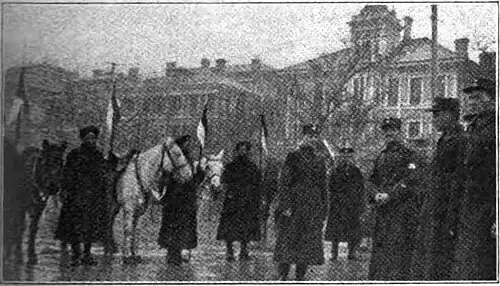
In guarding this line the Czechs undertook over 300 raids. This 1st regiment participated in 80. They lost 280 killed and over 800 wounded. Most of the men have seen five years of continuous fighting. Many have never heard from their relatives and know nothing about what kind of a home reception they will receive.
At one time this 1st regiment, when serving under Kerensky, captured 35 guns and took 10,000 prisoners.
The history of this Czechoslovak corps is the most romantic and remarkable of the war. Every page would be filled with thrills. And through all these dreary five years the men have kept up a most remarkable morale in which work the Y. M. C. A. has played no small part.
The Czechoslovaks are the most remarkable troops in Siberia, bar none. They are the best drilled, best hehaved and the best fighters. The entire world owes them a debt which can never be repaid. History will award them their proper niche in the hall of fame. Suffering Belgium, devastated France, ruined Russia, decimated England, illustrious Italy, and patriotic America will all in the future years bow in reverence over the graves of those brave, heroic soldiers who lie buried in the bleak graves on the hillsides from Vladivostok to Samara, in Siberia and European Russia, soldiers not of fortune, but with faith in the future, far from home, fighting for “Liberty, Right and Justice”, as did our forefathers.
THE CZECHOSLOVAK TRADE JOURNAL.
American visitors to Prague state that they managed to get along there very well in English. All educated men talk some English. Now the people there actually publish an English trade journal, the first member of which appeared last month.
The paper is written in excellent English, and the articles have the merit of abounding in facts and figures, rather than in rhapsodies on the country. Among the features of the first issue are discussions of the wood and timber situation, the exchange value of the crown, hops, beet sugar, alcohol, wool lace, as well as an account of import and export regulations and notes for travellers to Czechoslovakia, which are reprinted elsewhere in this periodical. Those of our readers who may be interested in trade between this country and the Czechoslovak Republic will find the Trade Journal very helpful. The address is Purkyňovo nám. 6, Prague-Vinohrady.
Under the patronage of their Majesties, the King and Queen of England, an All-Star British matine was given in London, at the Prince of Wales Theatre, on June 1st, 1920, in aid of the Czechoslovak fund for babies, of which Dr. Alice Masaryk is president. The honorary and program committees, in charge of the arrangements, were composed of leading men and women of the British Isles. The program was very interesting. Some of the foremost men and women of the British stage participated. The feature of the performance was the recital by Mrs. Patrick Campbell, of a sonnet written especially for that occasion, by Mr. John Drinkwater, entitled “England to Czechoslovakia”, which is printed in another part of this number.