Page:The Czechoslovak Review, vol4, 1920.pdf/249
April 18 was to be the first expression of public sentiment since the revolution.
Three parties were the principal contenders for the suffrages of the Slovaks. The old national party, rechristened a few months ago as the national farmers’ party, included most of the men who in the years before the war and during the war led the Slovak opposition to Magyar rule. Its great figure is Dr. Vávro Šrobár who after the revolution became minister of public health and at the same minister with special powers for Slovakia.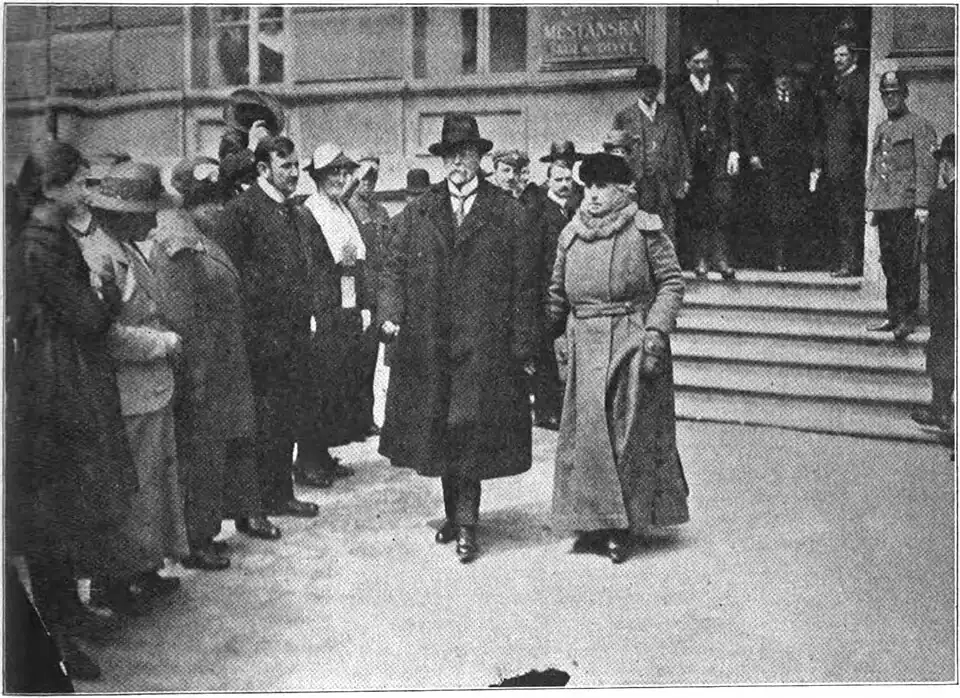
President Masaryk and his wife leaving the polling place.
While the entire Slovak Club in which Slovak deputies of all political beliefs were united entered the government coalition first under Kramář, later under Tusar, the national farmers’ party occupied a majority of the high political places and was thus held responsible for the faults of the government and for unpopular governmental measures. As regards the relations of Czechs and Slovaks, the national party favored the preservation of Slovak individuality, but not at the expense of the welfare of the Republic, and as a practical measure it favored a centralized government for the Czechoslovak Republic. Opposed to it was the people’s party, led principally by Catholic priests. Their war cry was Slovak autonomy. Some of the leaders were good Slovak patriots, like Father Hlinka who had suffered much from the Magyars in former years; men of his stamp were afraid of Czech socialists, Czech free thought, and wanted to keep the Slovaks as far apart from the godless Czechs as possible, without affecting the existence of the Republic or playing into the hands of the Magyars. But on the other hand only too many of the influential men in the people’s party were Slovaks who were such by blood only, whose secret sympathies were Magyar and who advocated Slovak autonomy, because they looked upon that as the first step toward the return of Slovakia to old Hungary. The third party were the social democrats who did not constitute a separate Slovak socialist party, but formed a part of the Czechoslovak social democratic party. They of