Page:The Czechoslovak Review, vol4, 1920.pdf/23
which they had known on political grounds in the old country, and they said to each other, “We came here expecting to find freedom, but here, too, there is persecution.”
This first priest, Rev. Ivan Volanski, was a good organizer, and in 1886 he and his parishioners completed the building of a little frame church, the first Greek Catholic church in America. In the next five years, he organized churches in Hazelton, Wilkes Barre, Scranton, and Jersey City, besides visiting and administering to many small and scattered communities. Finding his parishioners without reading matter, he sent to Galicia for Russian type, and in 1886 commenced the publication of a small newspaper, which he magnanimously called “America.” In 1889 an assistant was sent him, shortly afterwards another was needed, and since 1890 the great increase in Ruthenian immigration has been accompanied by an equally rapid growth in the immigrant church.
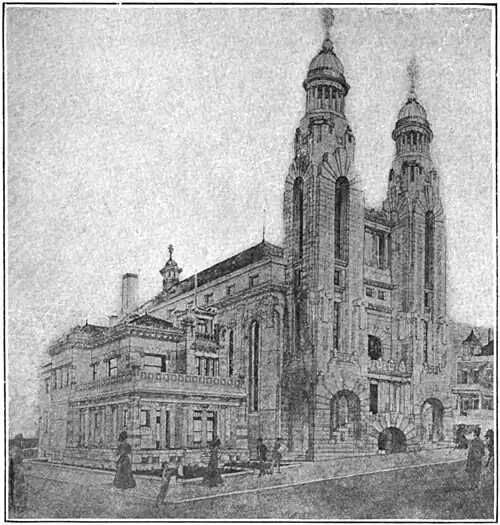
St. John’s the Baptist Greek Cath. Church, Homestead, Pa.
At first these churches were under the Roman Catholic bishops, but this arrangement was very difficult for both parties. To the Ukrainian, the Roman church was inseparably associated with the hated Polish domination, even in this country the Roman Catholic bishops being often spoken of as the “Polish bishops”; to the Uhro-Rusin, the Roman church carried the curse of Magyar domination; while the bishops themselves found their difficulties greatly enhanced by the intrusion of this new and disturbing element, with their different rites and rights. It was therefore a source of mutual satisfaction when the Pope decided to appoint a Greek Catholic bishop for the United States. The Rev. Stephen Soter Ortynsky, a monk of the order of St. Basil, the only order in the Eastern church, was so appointed, and arrived in August,