Page:The Czechoslovak Review, vol4, 1920.pdf/133
tainment is furnished every day from ten o’clock in the morning to nine o’clock in the evening.
The buildings are provided with a library and reading room, where the men find the latest magazines and newspapers; in the reading rooms also are played the usual indoor games such as chess, checkers and dominoes. The intricate game of chess, very little known among soldiers of other nations, is so popular here that ten times as many chessmen have to be furnished to Czechoslovakia, as to any other country in which the Y. M. C. A. work goes on.
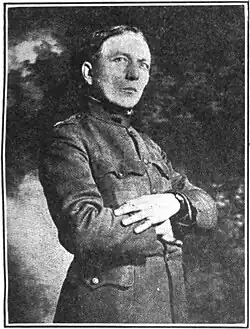
WM. REGNEMER,
Y. M. C. A. Secretary in Czechoslovak Army
Just as in the American army during the war, so in the Czechoslovak army now the Y. M. C. A. huts offer the soldiers free writing paper, envelopes and post cards; on the average five hundred pieces of mail are written daily in each of the buldings and dropped in its mail box, the contents of which are taken to the post office every night. In the eastern section of the Republic it is frequently impossible to buy a Czechoslovak post card or souvenir card in the local stores which are kept by Magyars, Jews or Germans; Magyar and German post cards cost from 30 to 40 hellers each, while the Y. M. C. A. huts furnish Czechoslovak post cards at 20 hellers and especially designed cards manufactured in large quantities are sold for ten hellers each—at the present rate of exchange one tenth of a cent.
Nothing is considered too good for the soldiers of this promising new Republic. The secretaries try to secure the best possible program for their entertainment, such as the violin playing of Jan Kubelik; cinemas as the moving pictures are called there, are given from two to four times a week to houses packed to capacity, all watching with appreciation and in perfect order the clean and instructive program. The best American films are used by simply translating the titles into Czech. Men occupying prominent positions in public life are called upon to give addresses on various subjects, such as: “Our consecration to the Czechoslovak Republic”, “Justice, equality and freedom is our motto”, “What we owe to the American people”, “How to take care of your body and health”, “Moral and spiritual welfare”, “Three remarkable men of American history, Washington, Lincoln and Wilson”, “Masaryk, the true son of Czechoslovak people”, “What is the American Y. M. C. A.” etc. Lectures are of great importance particularly in Slovakia. There is much musical talent in the army, and in many places the men themselves furnish a weekly concert, perhaps with help from local musicians. Outside talent is available also, and the best artists give concerts in Y. M. C. A. huts. Mass singing in many centres has become extremely popular, and it is really inspiring to hear the boys thunder their favorite national hymns and folk songs, songs that every Czech and Slovak knows and loves, such as “Kde domov můj”, “Hej Slované”, “Nad Tatrou sa blýská", “Moravo, Moravo”, “Mařenko”, “Boleráz”, “Pod našima okny”, “Přijde jaro přijde”, “Kdo za pravdu hoří", “Slovan jsem”, “America”, “Marseillaise” etc.
The work of the Y. M. C. A. for the soldiers does not confine itself to the furnishing of wholesome entertainment; it aims to employ the leisure of the men for their education. There are classes in classes in painting, basket making, English, French classes in Czech and Slovak literature. In Slovakia elementary courses in Slovak reading and