Page:The Czechoslovak Review, vol4, 1920.pdf/129
service of the nation and should make it great in fame and character, if not in mere numbers. The Czech Sokols were from the first animated by lofty ideals. The German Turners also trained their bodies, but their ideal was the mean one of domination and conquest of the world by the German race by any fair or foul means; and even the French gymnasts laid too much emphasis on revenge for the robbery of Alsace-Lorraine. Besides in no other nation did any single organization, athletic or otherwise, acquire such influence over the masses of the people, as did the Sokols in Bohemia. 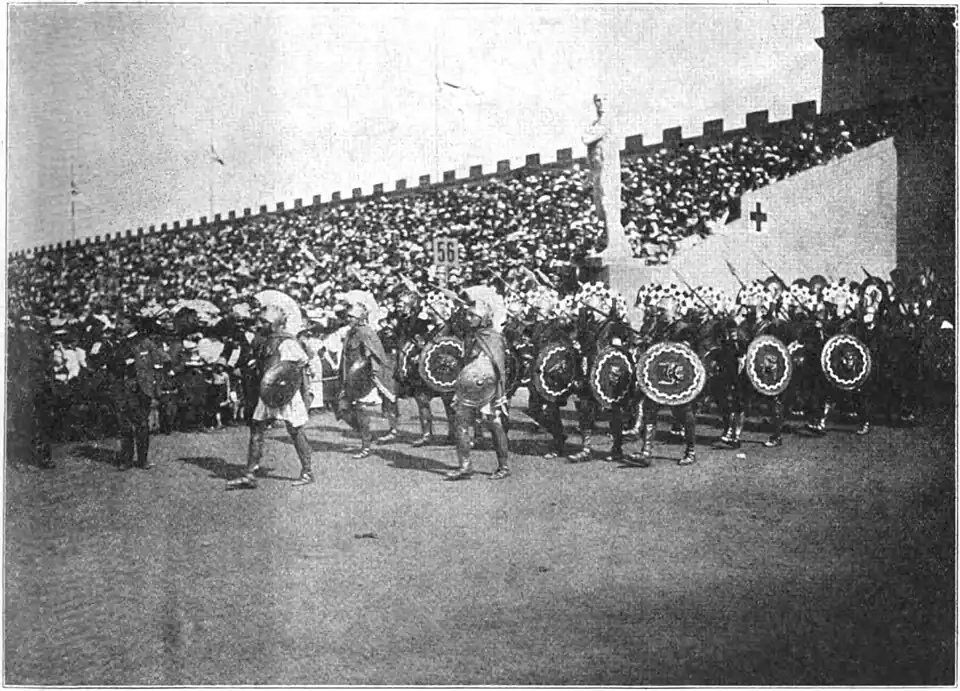
Battle of Marathon Reproduced at Prague in 1912.There is no body in America—Masons, Y. M. C. A., K. C., or whatever organization may be considered as exerting the greatest influence in the nation—that can at all compare with the standing, the moral force, the affection which the Sokols get from the Czechoslovak nation.
The seventh all-Sokol games present a vivid demonstration of the strength of this peculiar gymnastic organization. The number of men who will participate in the drill and the various athletic contests is now 27,000, and in addition, 17,000 women will take part; that is twice as many men and three times as many women as last time. After the great losses of the war this is a remarkable number, especially in view of the fact that the thousands of Sokols among the Czechoslovaks in Siberia are not included among those already entered in the lists. These tens of thousands of men and women from all parts of Bohemia, Moravia, Silesia and Slovakia will come to Prague at their own expense in order to compete not for purses, but for diplomas or laurel wreaths. If any athletic event of the year 1920 deserves the name of Olympic games, it is the Sokol “flocking together” in Prague, rather than official Olympic games in Antwerp.
Even though Prague will not have as many foreign nations representend or as