Page:The Czechoslovak Review, vol3, 1919.djvu/429
requests for the assignment of experts.
Czechoslovak Railway Post Office in Siberia. At the end of January, 1919, there were 95 factories under the direction of the Corps.
The work of Czechoslovak engineers and foremen had surprising results. Labor force became more efficient and increase in production averaged in January 35% and 39% in mines. Coal mines in Cheliabinsk increased annual production by 12 million pounds. Anthracite mines of Yagorshinsk, which the Bolsheviks had put completely out of working, were restored under Czechoslovak control in six weeks, and production was increased 200% against former rate.
All railroad shops were at once taken over and their capacity used to the full so as to remedy the terrible lack of rolling stock; efficiency of the Russian workers was raised by 35%.
Another creditable result was a saving in the consumption of raw material. Thus fully 50% of coal was saved and 60% of lubricants in the Verchiset plant under the direction of Engineer Splytek; this saving meant more than merely cutting down expenses, because of the great dearth of all raw material. Modern methods were introduced in foundries and rolling mills with considerable success.
Class struggle in Russia is far more severe than in the West, and since the Czechoslovaks had to keep the industries going and enjoyed the confidence of all classes, it was natural that they should be called in constantly as mediators. A special section was organized in the Technical Corps to settle industrial disputes. It received 116 oral and 204 written requests for its good offices, and in every case they managed to restore peace and keep the plant going. Both managers and labor unions sought the mediation of the Czechoslovaks or their advice.
The position of the Czechoslovak experts was not easy. They were frequently stationed at a great distance from the nearest garrison of their countrymen, alone among thousands of Russian workers, among whom Bolshevik agitators were always busy. But with the prestige of the Czechoslovak army at their back they managed to keep peace and order each in his special field, although two engineer officers and three foremen lost their lives in local up risings.
They exerted a great influence over the workingmen and kept them efficient far more successfully than Russian engineers, who were unable to gain the confidence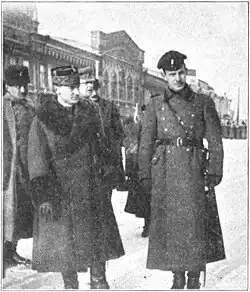
Gen. Rudolf Gajda (on the right) with the late Gen. Štefanik.