Page:The Czechoslovak Review, vol3, 1919.djvu/233
not always resist German intrigues or invitations to visit the general headquarters, where there were drinking bouts and orgies with women. Zitta cried, begged her husband to stay in Vienna and try to save the empire for the children by negotiations; but whether he gave in or ran away on a spree, she never weakened, and never gave up.
Zitta naturally found her principal advisers among the clericals. She selected her councillors with discernment and valued their counsel. For a long time she would not deal with the Magyars, with the exception of Count Zichy; she had no use for Karolyi who, however, gained access to Charles. But toward the end even Karolyi had to be consulted, for the Magyars foreseeing the bad outcome came around to her way of thinking and she became friendly with them. The Poles, that is to say Polish noblemen, were always in high favor.
As to the Czechs, Zitta knew little of them and was inclined to ignore them, because they had no national nobility and thus no access to her. She could not appreciate the strength of the people, and when she did realize how the Czech campaign for independence was undermining the very foundations of the Hapsburg empire, it was too late to conciliate them. The Bohemian nobility was not in favor at court, when Zitta was empress, partly because they had been friends of the late Francis Ferdinand, partly because they had no people back of them. Zitta realized that clearly.
It is well known that Zitta was on very bad terms with Emperor William and that she fought steadily against German military influences in Vienna. She had many tiffs with William, at first polite, later quite violent. Thus early in November 1917 William was in Vienna, accompanied by Hindenburg, to agree with Charles and the Austrian staff on future campaigns. Zitta of course was present. William expatiated on the German plans, emphasizing especially the downfall of Russia and bragging about an overwhelming attack on the western front in the spring. He had great faith in the work of the bolsheviks and wanted to spend sixty million rubles on them; Austria was to give a half. Charles had nothing to say, Zitta spoke for him. She underesti-
Courtesy of “The Americas.”
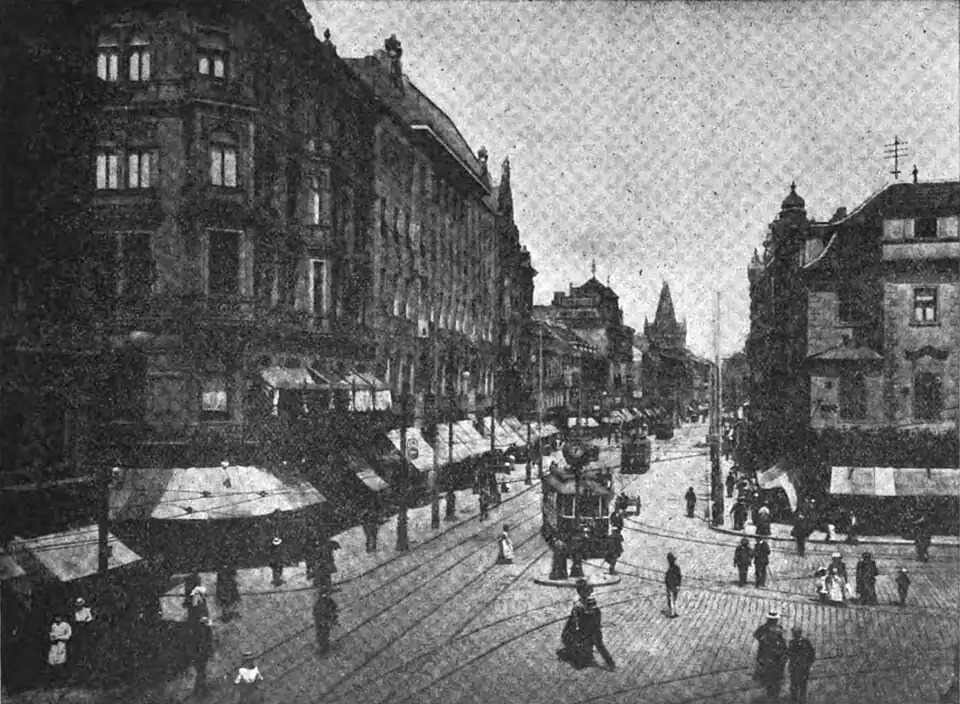
An old Thoroughfare of Prague now called “Boulevard Wilson”.