Page:The Biographical Dictionary of America, vol. 01.djvu/256
tions, in which he was eminently successful. In 1846, feeling the need of more help in his educational enterprises, he journeyed to France, and there procured Jesuit fathers to take charge of St. Joseph's college at Spring Hill, and a company of Brothers of the Sacred Heart for St. Mary's male orphan asylum. In 1847 he was nominated by the sixth council of Baltimore for the see of Vincennes, rendered vacant by the resignation of Bishop De La Hailandiere. He was consecrated at Vincennes, and died there April 23, 1848.
BEACH, Alfred E., journalist, was born at
Springfield, Mass., in 1826; son of Moses Y.Beach, who established the New York Sun. After obtaining an academic education at Monson, Mass., he entered his father's office, where he acquired a practical knowledge of newspaper work.
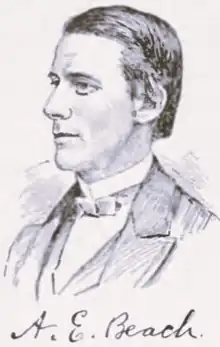 In 1846 he founded,
with Orson D. Munn,
a former schoolmate,
the firm of Munn &
Co., publishers, assuming control of the
Scientific American,
which at that time
was the only weekly
journal of a scientific
character published in
America. For nearly
fifty years Mr. Beach
was active in the editorship of the Scientific American, and in
the direction of the extensive patent business of
the firm. With his inherent taste for mechanics
and all branches of science he was well adapted
for the business he had chosen. His sympathy
with inventors and men of genius rendered him
very helpful to that class of people. About 1852
he invented a type-writing machine, which was
exhibited in operation at the World's fair, crystal palace, New York, and at the American institute exhibition in New York city from 1852 to
1855. It received the gold medal of the institute
as one of the most ingenious and important inventions then exhibited. The machine had a
keyboard, a pot of type-bars, an ink ribbon and a
spacing bar, the paper being moved by the keys.
About the year 1865 Mr. Beach devised a system
of carrying letters by means of underground
pneumatic tubes from the street lamp-posts
directly to the central post-office, and invented
many devices to perfect it. This led to the organization of the Beach pneumatic transit company, of which he was president. In 1867, at the
American institute fair in Fourteenth street,
New York, he had in operation, suspended from
the ceiling, a section of a pneumatic elevated
railway in which many persons rode. The success
of this experiment so convinced him of the value
of pneumatic power for the propulsion of cars
that he soon conceived the idea of constructing a
tunnel under Broadway, and planned a system of
underground railways for New York. In 1869,
legislative authority having been granted, he
constructed a section of underground railway extending from Warren street to Murray street.
This work was executed while traffic was going
on overhead, by means of the Beach hydraulic
shield, the first example of the machine which
was afterwards used in the construction of the
great railway tunnel under the St. Clair river
at Port Huron, the underground railway tunnels in London and Glasgow, the Hudson river
tunnel, and similar works. In 1860 Mr. Beach
founded and maintained a private school, with
a full corps of teachers, at Stratford, Conn.,
where he resided up to 1870, and soon after the
close of the civil war he founded the Beach institute at Savannah for the education of freedmen.
He died in New York city Jan. 1, 1896.
In 1846 he founded,
with Orson D. Munn,
a former schoolmate,
the firm of Munn &
Co., publishers, assuming control of the
Scientific American,
which at that time
was the only weekly
journal of a scientific
character published in
America. For nearly
fifty years Mr. Beach
was active in the editorship of the Scientific American, and in
the direction of the extensive patent business of
the firm. With his inherent taste for mechanics
and all branches of science he was well adapted
for the business he had chosen. His sympathy
with inventors and men of genius rendered him
very helpful to that class of people. About 1852
he invented a type-writing machine, which was
exhibited in operation at the World's fair, crystal palace, New York, and at the American institute exhibition in New York city from 1852 to
1855. It received the gold medal of the institute
as one of the most ingenious and important inventions then exhibited. The machine had a
keyboard, a pot of type-bars, an ink ribbon and a
spacing bar, the paper being moved by the keys.
About the year 1865 Mr. Beach devised a system
of carrying letters by means of underground
pneumatic tubes from the street lamp-posts
directly to the central post-office, and invented
many devices to perfect it. This led to the organization of the Beach pneumatic transit company, of which he was president. In 1867, at the
American institute fair in Fourteenth street,
New York, he had in operation, suspended from
the ceiling, a section of a pneumatic elevated
railway in which many persons rode. The success
of this experiment so convinced him of the value
of pneumatic power for the propulsion of cars
that he soon conceived the idea of constructing a
tunnel under Broadway, and planned a system of
underground railways for New York. In 1869,
legislative authority having been granted, he
constructed a section of underground railway extending from Warren street to Murray street.
This work was executed while traffic was going
on overhead, by means of the Beach hydraulic
shield, the first example of the machine which
was afterwards used in the construction of the
great railway tunnel under the St. Clair river
at Port Huron, the underground railway tunnels in London and Glasgow, the Hudson river
tunnel, and similar works. In 1860 Mr. Beach
founded and maintained a private school, with
a full corps of teachers, at Stratford, Conn.,
where he resided up to 1870, and soon after the
close of the civil war he founded the Beach institute at Savannah for the education of freedmen.
He died in New York city Jan. 1, 1896.
BEACH, Mrs. H. H. A. (Amy Marcy Cheney), musical composer, was born at Henniker, N. H., Sept. 5, 1867. She came of a musical family, who carefully fostered the talent displayed almost from her cradle. Her mother was her first teacher. From the time her hands could reach the keyboard of the piano she would find melodious combinations of notes and play the little airs she had heard. Reading music seemed to be instinctive with her, and when a mere child she could read at sight almost anything put before her. She also improvised with remarkable taste, and composed several little airs with odd and pretty accompaniments. At as early an age as was deemed expedient she was placed under the best Boston instructors, and her progress was phenomenal. In 1883 she played in Boston the G-minor concerto of Moscheles, with grand orchestra. She was married in 1885 to Dr. Henry Harris Aubrey Beach, a prominent Boston physician. Mrs. Beach composed a Mass in E-flat, which was performed in 1892 by the Handel and Haydn society, and which has been pronounced one of the grandest musical compositions ever produced by a woman. In 1893 "Festival Jubilate," written for the World's Columbian exposition at Chicago, attracted much favorable comment. During the season of 1895-'96 she played with the Boston symphony orchestra. Among her compositions are a scena and aria, "Eilende Wolken," for contralto, with orchestral accompaniment; cantatas for male and female voices, with and without orchestra, and more than sixty shorter works for piano, violin and one or more voices; a sonata for piano and violin, and the "Gaelic" symphony, performed in 1896 by the Boston symphony orchestra.