Page:The Biographical Dictionary of America, vol. 01.djvu/225
BARRETT.BARRETT.
BARRETT, Edward, naval officer, was born in Louisiana in 1828. From 1841 to 1846 he served as a midshipman, chiefly abroad. He then entered the naval academy at Annapolis and was graduated the same year. He served through the Mexican war, and at its close was assigned to the African coast station in 1848, as commander of the sloop Jamestown. In 1855 he was advanced to the grade of lieutenant, and after a few years more of service was made instructor of gunnery. He was subjected to court-martial in 1862, on the charge of disloyal conduct, but the evidence fully exonerated him, and he was given command of the gunboat Massasoit, having been promoted lieutenant-commander. He then commanded the ironclad monitor Catskill, and captured the blockade-runner Deer. He ascended the Yangtse-Kiang river to Hankow, and commanded the man-of-war that tested the jetties of the Mississippi river when completed by Eads. He is the author of "Dead Reckoning; or, Day's Work" (1863); "Temporary Fortifications: Prepared for the Naval Service" (1863); "Naval Howitzer" (1863); and the editor of "The Carlyle Anthology," selected and arranged with the author's sanction. He died in March, 1880.
BARRETT, George Carter, jurist, was born in Ireland, July 28, 1838; son of a clergyman who immigrated to Canada as a missionary in 1840. George was adopted by his uncle George C. Barrett of New York city in 1851; studied law under his uncle and was admitted to the bar in 1859. He practiced with his uncle, 1859-'63; was justice of the 6th district court of New York city, 1863-'67 and of the court of common pleas 1867-'71. He was active in the overthrow of the "Tweed-ring;" an organizer of the mass meeting held Sept. 4, 1871, and as counsel for the "committee of seventy," prevented Richard B. Connolly from acting as comptroller. He was a justice of the New York supreme court, 1871-'95, and of the appellate division in 1896. He wrote the play "An American Marriage" (1883).
BARRETT, John, diplomatist, was born at Grafton, Vt., Nov. 28, 1866; son of Charles and Caroline (Sanford) Barrett. He was graduated at Dartmouth college in 1889; taught at Oakland, Cal., one term; and was assistant editor of the Statistician, at San Francisco. He traveled in South America, Japan and China; as correspondent of the Ledger, Tacoma, Wash., and was associate editor of The Evening Telegram, Portland, Ore., 1891-'94. He was a delegate to the Democratic national convention at Chicago, in 1892; U.S. minister resident and consul-general at Bangkok, Siam, 1894-'98, where he settled the claim of Dr. Cheek against Siam, obtaining an award of $250,000. He was the war correspondent of New York, Chicago, and San Francisco papers at Manila in 1898, and a delegate to the International conference of the American states at Mexico in 1901. He is the author of "Admiral George Dewey" (1899); "The Far East and Siam" (1902).
BARRETT, John P., electrician, was born near Auburn, N.Y., in 1837. He removed with his parents to Chicago in 1844, and when twelve years old went to sea as a ship's boy, rising to the position of an able seaman. In a storm off the coast of Chili he fell from aloft, and was crippled for life; but after nearly two years of suffering, in a San Francisco hospital, he regained his health, returned to Chicago in 1862, and was appointed fire watchman in the tower of the city hall. On the introduction of the fire telegraph in 1865, he was appointed assistant operator, and during his connection with it, improved the fire alarm telegraph system which became generally adopted throughout the country. As chief electrician of the Chicago fire department he improved the box system until it was automatically perfect. His "joker" in the engine houses, was so constructed as to instantly release the horses from their stalls at the sound of the alarm, and to rouse all the firemen from their beds, while his "still switch" served to call only a part of the men, while the others were allowed to sleep undisturbed. He also turned his attention to the police patrol system, the underground telegraph, the bridge telephone, the lighting of Chicago’s streets and river, and in recognition of his great services in these various departments he was appointed chief electrician to the World's Columbian exposition of 1893.
BARRETT, Lawrence, actor, was born at Paterson, N.J., April 4, 1838. He sprang from an obscure family, his father being an Irish immigrant, too poor to educate him properly, but the boy possessed an insatiable craving for reading, and lost no opportunity to study history
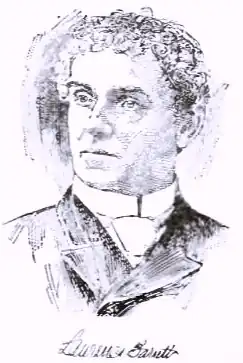 and literature. His first work in a theater was as a call-boy in Detroit, and there his love for the drama was awakened. His spare moments were occupied in reading plays and his acute observation readily grasped the details of the actor’s art. From call-boy he worked his way up to a speaking part, and in January, 1857, though not nineteen years old, he made his first appearance in New York city as Sir Thomas Clifford in the "The Hunchback," play-