Page:St. Nicholas (serial) (IA stnicholasserial321dodg).pdf/80
away a portion of the wood on opposite sides of the ends which are to be joined, so that, when fastened, the wood will appear as a continuous piece. For corners and angles where a miter-box is not available the lap-joint is a very good substitute, and for many things it is stronger than the mitered joint, and much to be preferred.
Fig. 7 is another form of lap-joint, when the end of a strip is embedded in the surface of a stout piece of wood. This joint is very useful to the carpenter when making furniture, and for frame construction in general. Fig. 8 is a beveled lap-joint, and is used for timbers and posts under certain conditions where the joint can be strengthened by another piece of wood at one or two sides, Fig, 9 shows a tenon and mortise; the hole in the upright piece is the mortise,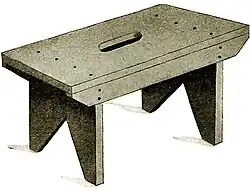
A Low Bench. and the shaped end on the stick is the tenon. The shaped end should fit the hole accurately, and the joint is usually held with a pin or nails driven through the side of the upright piece and into the side of the tenon when embedded in the mortise.
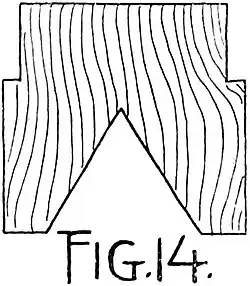 Fig. 12, A, is a rabbet, and is cut on the edges of wood where other pieces of wood fit into it, or where wood laps over some other material, such as glass or metal. The inner molding of picture frames is always provided with a rabbet, behind which the edge of the glass, picture, and backing-boards will fit. Fig. 12, B, is a rabbet-joint made with a rabbet and groove, and is a good one to employ for box corners, bottoms of drawers, and where the edges of two pieces of wood come together. Fig. 13 is the dovetail-joint used for boxes, drawer comers, chests, and sometimes in cabinet work where the corners are to be covered with moldings or edging strips. Fig. 13, A, is the straight dovetail employed in the cheap construction of small boxes for hardware, groceries, and other wares, and is, of course, the easier of the dovetail-joints to make.
V. A Low Bench.
Small benches are always very useful to work upon when sawing, nailing, and matching boards; and the uses to which benches can be put are too numerous to mention, for they are quite as useful about the house as they are for a part of the carpentry outfit.
The low bench is fifteen inches high and twelve inches wide, and the top is twenty-two inches long, The foot pieces are cut as shown in Fig, 14, and at the upper end at each side a piece is cut out to let in the side aprons. The aprons are three inches wide and seven eighths of an inch thick, and are held to the foot pieces with glue and screws. In the top a finger-hole is cut, so as to lift the bench easily.
V. A Step-bench.
From the details given above it will be an easy matter to make the step-bench shown on the next page. This is thirty inches high and fifteen inches wide. The top step is eight inches wide and the lower steps six inches.