Page:St. Nicholas (serial) (IA stnicholasserial321dodg).pdf/499
Herbert K. Job.

The Loon.
Habits of Herring-gulls.
Newton, N. J.
Dear St. Nicholas: Last summer, while crossing Lake Ontario, I was very much interested in watching the gulls—the large gray and white birds found near the water. After flying some distance I noticed that they would drop on the water, evidently for rest, and then fly on again. Your interested reader,
Florence R. T. Smith (age 15).
The gulls are undoubtedly Larus argentatus, herring-gull. Gulls do not dive into the water for food, as the terns do, but either snatch it from the surface, or rest upon the water, as here noted, and glean from the surface. They usually perch upon fishnet posts to rest but where these are lacking rest upon the surface of the water. After a flock has been disturbed it seems to prefer to rest on the water.
Professor Lynds Jones.
The name “herring-gull” probably comes from the commotion they make at sight of a school of herring or other little fish. As they follow the small fry about, the fishermen often take them for pilots and follow to get the larger fish, which are in pursuit of the little ones.
Florence Merriam Bailey.
Very Friendly Gulls.
Hotel Trois Couronnes,
Vevey, Suisse.onnes,
Dear St. Nicholas: I am writing to tell you about some gulls who come to our window every day. Each time we go to the window they come, expecting to get some bread. Sometimes they will take it from our hands, but that is rather dangerous, as in their hurry they are apt to take a finger by mistake in their sharp beaks.
I am sending you a photograph of them, settling on the leads of our hotel. They are smaller than the seagull and are pure white in the winter. In the spring they partly change color, having black heads and tips of wings and tail; the rest of the body is dove-color. They are beginning to change now (November) and look very funny. The black feathers are on each side of the head, making them appear to have black ears. In the spring they suddenly disappear, going up the Rhône valley for a short time. Dorothy Turner (age 10).
These are probably the black-headed gulls (Larus ridibundus). The black head is a characteristic of the summer plumage. This color disappears in the autumn and winter.
This letter, noting slight seasonal color-changes, suggests an account of the Western ptarmigun, that has greater changes. Who can supply good life-photographs of the ptarmigan? E. F. B.
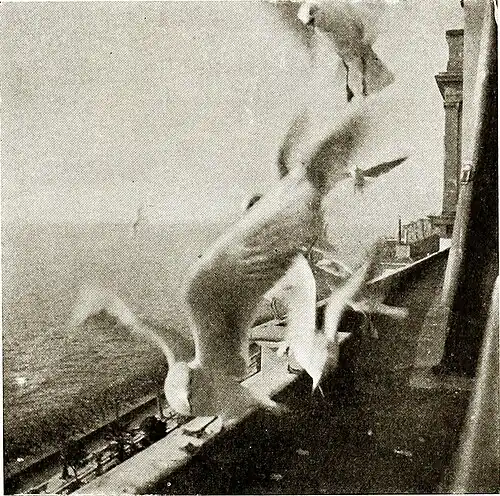
Very Friendly Gulls.
Although some parts of this photograph are not sharply defined, chiefly because of the very rapid motion ef the wings, it is published because it excellently shows the positions of the wings in alighting, and also vory expressively tells us of the friendliness of the birds as the writer of the accompanying letter saw them.