Page:St. Nicholas (serial) (IA stnicholasserial321dodg).pdf/498
Like Pieces of Chamois Leather.
Argyle, Minn.
Dear St. Nicholas: One day, as I was chopping wood, I noticed that between the bark and the wood of the piece of wood I was chopping there was a white layer of skin. Most of it was very strong. This was on a piece of oak-wood which, I believe, is called red oak. I send you a sample of it. I would like to know what it is and how it is formed.
Yours truly,
YoursCarl Olsen.
This spongy material, with some resemblance chamois leather, is a mass of the “roots” (mycelinm) of a fungus growth. The species you send is probably that of Polyporus sulphureus. This species and P. pinicola and P. ponderosæ are the principal wood-destroying fungi, forming felt-like growths of this sort, which occur in the United States, P sulphureus occurs mainly on oaks and chestnuts.
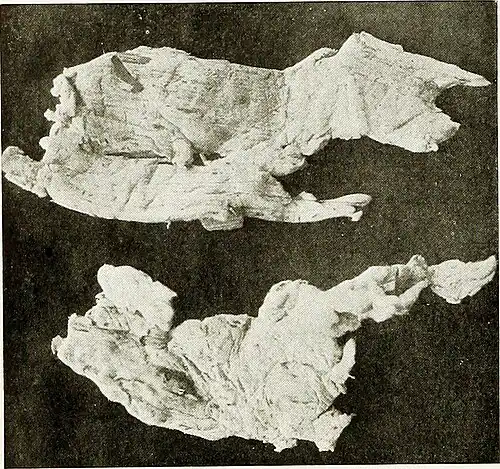
The fungus growth that looked like pieces
of Chamois leather.
This growth occurs on fallen trees, and also on living trees which by fire, wind, or human agency have sustained injury sufficient to expose the heart-wood. The sap-wood is never attacked. The growth, under favorable conditions, may extend throughout the tree, and will produce fruity bodies—known as the shelf-fungi—upon the tree trunk. The spores, carried by the wind to a fallen tree or a living tree which has been seriously injured, germinate; and there again results a felt-like growth which in its turn destroys the wood.
The Winter Home of an Owl.
Fitchbburg, Mass.
Dear St. Nicholas: I have something interesting to tell the boys and girls who read the St. Nicho1as. It is about a tenant that we have,
The tenant is an owl who has come for the third winter to our house to make his home. He comes in October and stays until the warm days in March. Last March one of his mates came for him and they went away together. This fall he came back alone.
On the front of the house there is a round hole in the point of the gable, just large enough for him to enter. Here he sits nearly all day. His head and a little of his breast is all that can be seen of him as he sits there. Just about twilight he flies away to get his food. The people about here take a great interest in him. They look for him each time they pass the house, People from out of town have come to see him.
Very truly yours,
Very Lucy May Montgomery(age 13).
The Nest of a Loon.
Chicago, Ill.
Dear St. Nicholas: Does a loon sit upon its eggs or leaye the sun to hatch them? In the spring I found a loon’s nest; but no matter how careful we were of our approach, we could not catch the loon upon her nest or find any signs of her having been there. We could see her swimming, but never near the nest. Is it common for a loon to have only one egg? That is all this one had, and all the natural-history books I have looked in said two. Does the male have a nest near the female? There were two nests on this island, and one had no eggs in it. We could see two loons.
Yours very truly,
Yours vCarroll C. Kendrick.
The loon incubates its eggs ordinarily, though I do not doubt that on suitable days, neither too cold nor too hot, it may leave them for some little while. The reason you could not see the bird on the nest is that she is very wary, and always slides off into the water whenever a boat or a person is seen in the distance approaching. I have sometimes been able to surprise one on its nest on a rainy day, when there were rushes or grass near the nest to help hide my approach. The nest is at the water’s edge, and the bird, slipping in, at once dives and shows itself only when it has swum under water a long way off. Two eggs is the more common number, but one only is often a full laying. I once found a nest with only one egg, on the point of hatching.
The male bird would not have had a separate nest, though he might have had a spot on some