Page:St. Nicholas (serial) (IA stnicholasserial321dodg).pdf/377
species of frogs always jumped when touched. Walking is easicr than jumping, and the big old fellows take the easiest way when they can. My big frog could also climb.
Your letter points out a marked characteristic of the toad (and I may add that the same was true of my big frog)—its caution. Young frogs and smaller species of frogs seem to have but little, if any, caution. They jump recklessly, often alighting many feet below their starling-point, Common turtles also lack caution. They will crawl off anything, even if it be an upper veranda-floor, without taking forethought as to their probable landing-place. They seem to trust to luck in this respect.
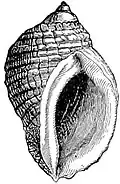
(Purpura lapillus.)
Some Cape Ann Shells
Gloucester, Mass.
Dear St. Nicholas: Just after a storm at low tide is the best time to collect shells on the bench. Then, if at any time, the rare shells are found. On the beaches of Cape Ann one may collect{{img float |file=St Nicholas-32-1-377-3.jpg |width=90px |align=right |cap=Shell of a Periwinkle (Littorina litmea.) between twenty-five and thirty different specimens in an afternoon.
Among the most common sea-shells are the Mya arcane, called the common clam, which is found in great abundance on the mud flats, and the Purpura lapillus and Littorina litorea, found in large quantities clinging to the rocks at low water.
Those that are rarely found are the Pandora trilineata, which is a small, pearly shell, and the Thracia conradi,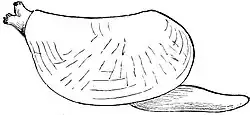
Remarkable Flat Shell (Pandora tilineata.) having a very beautiful shell, both bivalves.
At low water the Soleo ensis (or razor-clam) is seen alive just above the sand; but it is not an easy matter to catch it, for at the slightest disturbance it will instantly disappear, leaving behind nothing but the smooth sand.
All shell animals are very sensitive 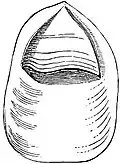
Little Boat-shell (Crepidula.)to noise, quickly closing their shells if they hear any sound. It is almost impossible to remove a shell from the rock to which it is clinging without injuring it. Not only do shells live on the rocks, but they are found beneath stones, among seaweed, and burying in sand and wad. By using a dredge one may get live specimens of shells found in fragments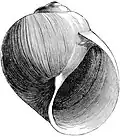
Shell of Common Marine Snail (Polynices heros.) only upon the beach. Very few large shells are found about Cape Ann, while a great many are so small that they can hardly be seen.
One hundred and eight different specimens, including only about ten known fresh-water and land shells, have been collected on Cap Ann.
When an animal outgrows his shell he enlarges the same by building it out with a fluid with which nature has provided him. Shells are divided into two classes: those which consist of one part,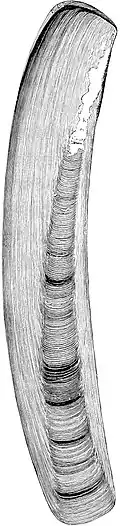
The Razor-shell (Solen ensis.) often assuming a spiral shape, called the Gastereopoda, and those consisting of two parts, called the Acephala.
The shells belonging to the Gastereopoda are much more abundant than those belonging to the Acephala, but as a rule they are usually smaller. The Crepidula plana has a very queer habit of living within the shell of a natica, and is rarely found clinging to a rock, while the Crepidula fornicata is never found within a shell, but always on a rock.
Marjorie C. Newell.
A liberal supply of the specimens collected on the beach was sent to the editor of the Nature and Science department. The accompanying illustrations show a few of the many kinds.
This letter shows that the writer is a true nature-lover. She evidently has the ability to see things, a desire to collect and to know more about them, and an appreciation of the beautiful.
Will some of our young folks please write to us about fresh-water and land shells they have seen?