Page:St. Nicholas (serial) (IA stnicholasserial321dodg).pdf/249
another, When I put my foot in front of it, it ran away. Will you please tell me if it had killed the other one, or found it dead, and commenced to eat it?
Your interested reader, Etta Coulter.
Crickets usually feed upon plants, but occasionally they eat other insects. I find no record of their killing and eating other crickets, but your observation makes me suspect an insect murder and cannibalism. What do you think yourself?
Varying mimicry in one “brood” of Chrysalides.

The home of the writer of the accompanying letter.
Showing the location of the vines (Dutchman’s-pipe) on the porch. It was on the leaes of thes vines that the brood of caterpillars fed.
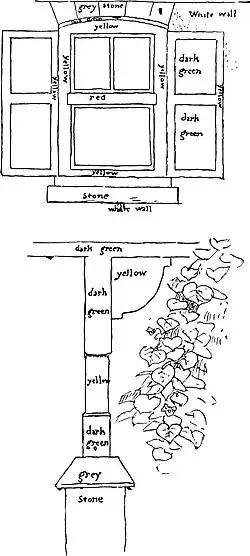
Diagram of post and surroundings
Showing the various colors in the vicinity. Each member of one brood of caterpillars, in becoming chrysalides, located on or near some one or more of these various colors.
Lansdowne, Pa.
Dear St. Nicholas: On one side of our porch is an Aristolochia, or Dutchman’s-pipe, and every year a great many larva: of the blue swallowtail butterfly Laertias philenor, feed on the leaves. We usually kill all the “worms” we can find, for of coarse they spoil the looks of the vine. This summer we were away for a month, and were very much surprised, on returning home, to. find nearly everything around the porch hung with the chrysalides. A strange part is that they vary very much in color. Some are bright, some a light green, and others are of different shades of brown. Three or four are clinging to the stems of a jasmine, and are so exactly its color that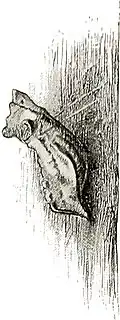
One of the chrysalides.
Showing the unique way it has of fastening itself on the wall by a thread of silky material. it is very hard to see them. With almost no exception, the brown ones are on the stone posts, dead twigs, wire which supports the vine, and such dull-colored things, while the green ones are on or very near green stems, A rose-bush is growing by one post, and a chrysalis on
the post, but very close to the bush, is light green. Another hanging on some woodwork painted a dark green is nearly the same color, and very noticeably darker than the others. I inclose several sketches. One is the post, on the upper part of which clung the dark green one (since destroyed) and also several others. The chrysalis
which I found nearest the rose-bush was light green, like two of the specimens I send you. Those which were on the under part of the stone
were brown.
The second sketch shows the place between the water-stained plaster and the water-pipe where I found the inclosed brown chrysalis. The wall is stained dull brown very much the same color.
Very truly, Your interested reader,
YoAnna D. White (age 13).
This is a marked example of protective mimicry, in that the members of the same brood went to various colors, and each “mimicked” the color of its location.
We cannot help calling especial attention to this very interesting and very well written letter from an observant young reader.
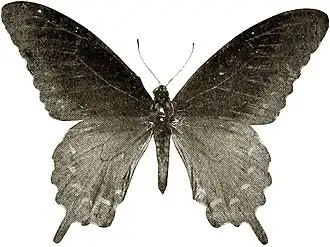
Each chrysalis became a blue swallowtail butterfly.
(Laertias philenor)