Page:St. Nicholas (serial) (IA stnicholasserial321dodg).pdf/245
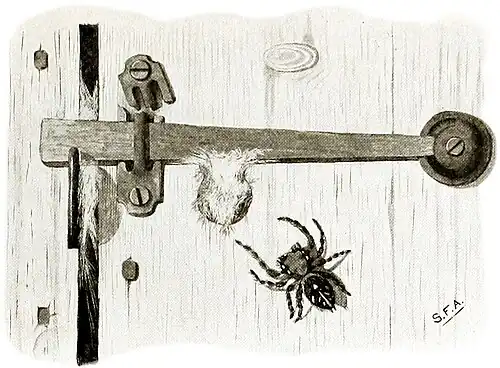
The little black and spotted jumping-spider (Attus) and his nest under the latch of an old disused barn door
The nest in the hole from which the life had been taken was the one in which the spider found shelter, and when a straw was poked in on the other side the small occupant backed out this side, always, as is their habit, keeping its front eyes on the intruder. The nest in the chink between the door and the wall contained a batch of the spider‘s eggs.
Samuel Francis Aaron.
Jumping-spiders attract our attention by their short stout legs, bright colors, big eyes. and quick movements.—E. F. B.
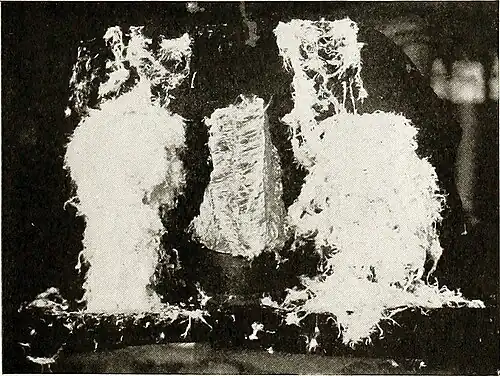
A Block of Asbestos.
(On the right and left of this block are shown masses of the cottony form into which the crude asbestos is broken.)
A Fireproofing Mineral.
You have probably heard the word “asbestos” used in connection with theater curtains, and with methods of rendering a theater or other building fire-proof. Asbestos is a fibrous mineral that cannot be burned. Chemically, it is a silicate of lime and magnesium. When torn to pieces in a machine made for that purpose, it looks like a mass of cotton, and these fibers can be spun into threads or strings, and then woven into fabrics useful for various purposes. The Welsbach mantles of our gaslights are tied to a supporting wire by a piece of asbestos string.
It is stated that the ancient Greeks made wicks of the fibers and used them in the sacred fires in their temples. It is also claimed that napkins were made of this material, so that they might cleaned be by fire.
The fibers of asbestos have a silky luster, and in color are while, gray, green, or a green-gray.
Various articles manufactured from asbestos.
Note.—For courtesies and use of specimens for photographs we are indebted to Mr. J. B. Johnson, with H. W. Johns Manville Co., New York.—Editor.)
True and False Legs of Caterpillars.
Every caterpillar has three pairs of true legs on the fore part of its body, corresponding to the six found in the butterfly or moth. These are terminated by a sharp claw.
There are also, in most cases, four pairs of prolegs along the middle of the body and one pair at the rear. These ten prolegs disappear when the cater-