Page:St. Nicholas (serial) (IA stnicholasserial321dodg).pdf/206
scene naturally, as it may have happened, and has introduced, around the Virgin, figures studied from the actual men who walked the streets of Nuremberg in his day, while Raphael's persons are idealized—are imagined by the artist to express the idea which was in his mind. It is the same with his arrangement of a throne, an arch, and a landscape. The scene is not a real one; it is made up of things selected in order to suggest to our mind the idea which was in his. Here is a sharp distinction in the way of seeing the facts of nature. One artist sees in them something to be copied or reproduced as accurately as possible; the other extracts from them an ideal view, on which he may found some fabric of his own imaginaton, From the one we get an impression of reality which is apt to go no further than would a mere beholding of the scene; but the other satisfies or excites our own imagination.
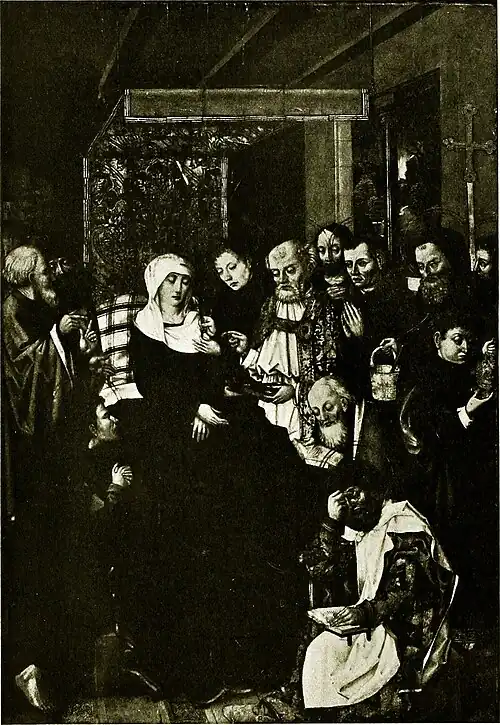
“The Death of the Virgin.” by Wohlgemuth.
Raphael was filled with admiration of the art of ancient Greece. He loved to paint scenes from the beautiful old myths, such as the story of “Galatea,” of “Psyche,” and the rest. And in some of his greatest paintings, beneath the arches of a noble building in Rome, he has pictured for us not only Dante and Petrarch and other great Italians of the Middle Ages, but also the greatest men of old Greece— Plato, Aristotle, Pythagoras, Socrates. It is almost as if through Raphael the beauty of the antique world was brought back to the sight of modern men.
But even more remarkable is what Raphael did in representing Bible scenes and sacred subjects. As a gardener will blend the pollen of two kinds of flowers and produce a third, which unites the beauties of the two, so Raphael blended the Grecian and the Christian in his