Page:St. Nicholas (serial) (IA stnicholasserial321dodg).pdf/113
The wild carrot grows in profusion all around, and we must stop and look at a plant. The feathery leaves, almost the prettiest part of the plant, grow in a bunch upon the sand and from them rise the rough green stalks. How delicate the flowers are! The little brown speck in the center of each flower seems to accentuate the delicacy, and a pleasant carroty odor lingers around the plant, and grows stronger as we break the stems.
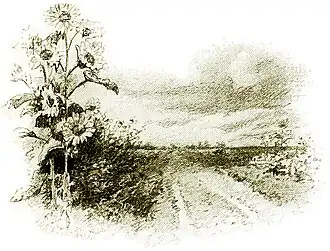
The “weedy” sunflowers by the roadside.
If we should take a look at this same field in winter we would sce the dried flowers, known as bird’s-nests, standing stiffly above the snow. A flock of chickadees, balancing on them, eat the sharp-pronged seeds, which seem to us hardly palatable.
Catherine Lee Carter (age 14).
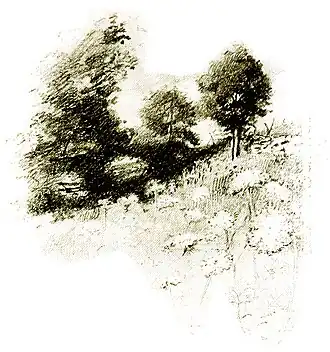
Queen Anne’s Lace in a corner of a field.
The pest of the farmer, the delight of the naturalist.
It is only when we desire to cultivate certain plants that others become weeds—for “a weed is a plant that persists in growing where it is not wanted,” Hence the farmer is troubled with many weeds, for many kinds of plants struggle against the few kinds he wishes to have grow. Even the daisies in the mowing-lot and the goldenrod along by the pasture wall he regards as weeds. Aside from any desire to cultivate certain plants, our young folk regard all plants as does the grown-up botanist. All are beautiful and interesting, and none more so than those called weeds merely because they are very persistent in living and growing. And how interesting are the many forms and the zeal in the struggle for life! John Burroughs has well described them:
One is tempted to say that the most human plants, after all, are the weeds. How they cling to man and follow him around the world, and spring up wherever he sets his foot! How they crowd around his barns and dwellings, and throng is garden and jostle and override each other in their strife to be near him! Some of them are so domestic and familiar, and so harmless withal, that one comes to regard them with positive affection. . . . Knot-grass, that carpets every old dooryard, and fringes every walk, and softens every path that knows the feet of children, or that leads to the spring, or to the garden, or to the barn, how kindly one comes to look upon it!
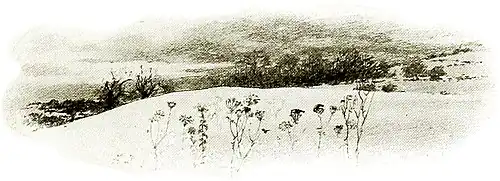
The Wild Carrot in Winter.