Page:St. Nicholas (serial) (IA stnicholasserial321dodg).pdf/112
ble description from March to November. To the child from the pavements they would be a source of never-ending delight; but to the farmer lad who has to hoe them they are just weeds—rank, ugly weeds, to be cut and beaten out of existence. The queen of Kansas weeds is, of course, the sunflower. It begins early, and, if left alone, it grows and grows, until in July the stalk, as big as my wrist, sends out the gold-and-brown faces nodding above my head. The sunflower grows mostly along the roadsides, for if a field is properly cultivated they are not hard to destroy.
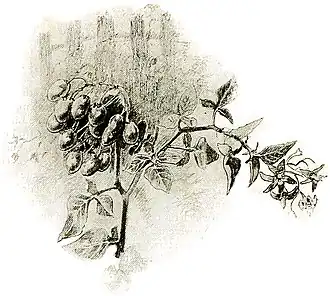
The berries of the nightshade
The jimson is an energetic weed which is not at all particular as to its location. If it happens to be in a rich garden spot, it is not at all backward in making itself conspicuous. But a dry, hard feedlot or barnyard is where it feels most at home, There, if unmolested, they will grow so closely together and in such proportions that, trying (o pass through them, one might think he had discovered a miniature forest. The plant has a white trumpet-shaped flower several inches long; and the seed-pod is about the size and shape of a good-sized plum, but covered with prickles. One of the most brilliant of weeds is the morning-glory. There is no lack of variety in color—sky-blue, deep purple, pink, or all these in one. When allowed to run riot they turn a thrifty (?) farmer’s field into as beautiful a flower-garden as you ever saw. Imagine a field of Kaffir corn with stalks bending over with the weight of hundreds of glories, Bur the morning-glory which causes most sorrow for the farmer is the “white” morning-glory, called by some the “wild sweet potato.” This is a perennial and has a fleshy root, It does no goud to plow it up, for every joint of root or vine which touches the ground straightway sends out another plant,
There is the cockle-bur, which can be described only as a bur, just a little bunch of prickles. This is one of the most troublesome of weeds, It generally grows after the corn is “laid by,” and if the farmer is to thoroughly remove it he must go over the field and pull it by hand, In a field of fifty to one hundred and fifty acres this is no small task, There is also the stick-tight, or devil’s bootjack, As the seeds grow on the stalk, they form a sort of ball; but let this brush against one’s dress, it instantly flies to pieces, and each little seed or “boot-jack” turns upside down and fastens by its prongs.
Of the thistles, the most innocent-looking is the Russian thistle, When young, it looks like a handful of green hair. But as it grows the little hairs become stiff bushing stalks, changing the pretty little plant to an ugly thing almost as large as a wagon-wheel. When the wind loosens it from the earth it goes rolling and tumbling over the prairies until stopped by a fence or grove. For such a harmless weed, it caused quite a commotion on its advent to us country. Congress came very nearly appropriating a surprisingly large amount of money for its extermination.
Your constant reader,
Fern L. Patten, (age 16).
The weeds of the fields.
Wendiiam, N. J.
Dear St. Nicholas: Imagine a waste field, where the hand of man is not felt, a side-hill field bounded by a stone wall. Along the edge of the woods the blackberry bushes have grown tall and have mingled with the sumac that flaunts its glossy leaves in the bright
sunshine, The late wild-roses and early goldenrod are here, but it is with the weeds that we are con-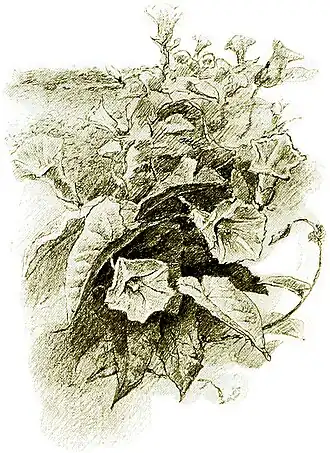
The wild morning-glory.