Page:St. Nicholas (serial) (IA stnicholasserial321dodg).pdf/111
The beauty and interest of weeds.
Decatur, Ill.
Dear St. Nicholas: Across the commons from us there stands a little brown house where nothing thrives but poverty and weeds and happiness. Year after year the garden fails and the flowers die, but the weeds grow tall and straight and strong, and bring joy to the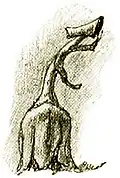
“Lo! There stands an
ancient dame in green
kirtle and crumpled
yellow petticoats.”
This is the fruiting of the Indian mallow (Abutilon.)Little Girl, The Little Girl is a strange little girl. All the drowsy summer afternoons she lies in the shade of the great ragweeds, and dreams and plays. To her the ragweeds are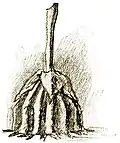
“This, inverted, the
little girl uses as a
potato-masher for her
pebble potatoes.” not ragweeds: they are tall, glorious trees wherein dwell wondrous songsters; a ladybug is a redbird, and a wandering fly a nightingale. At her head in a break in the ragweeds grows a tall buttonweed, ‘Lo the Little Girl its rich, golden lossom is as beautiful as the choicest rose. In the center is a wonderful bed of stamens—and the sepals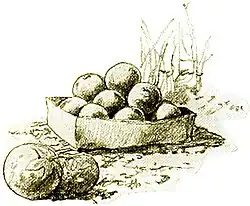
“The green-golden berries
furnish oranges for the dolly’s
table.” and petals are a gaily painted fence. Or, sometimes, the Little Girl turns them upside down, and lo! there stands ancient dame in green kirtle and crumpled yellow petticoats. The seed-pod is no less wonderful to her, Many a time she has pondered over its wondrous molding, and the blending shades of green, light at the top and shading down into dark, almost black. This, inverted, the Little Girl uses as a potato-masher for her pebble potatoes—but in her heart there is no lack of reverence.
At her feet, in company with the “tickle-grass,” the bull-nettle and nightshade grow side by side. To the Little Girl the berries of the latter two are the most beautiful of all the weeds. Big brothers have forbidden her to touch them, but she does not understand, and the green-golden berries of the bullweed furnish orangess daily for the dolly’s table. The strange structure of the nightshade berries she cannot understand; the thin transparent green walls through which the tiny seeds can be seen puzzle her.
“I guess they were made that way so that they could look up and see the stars,” she confided to me, one day. She meant the pure white, star-shaped blossoms with their protruding little yellow eyes, and I could but agree.
A vigorous growth of smartweed with the delicate pink and red and white blossoms fringes her playhouse—some of she plants at least two feet high, “These the Little Girl does not value so much; she plucks them to pieces, part by part, to see how many different colors of pink she can find, and then, in a fit of contrition, drops the poor mangled blossoms into the pan of cool water placed in the weeds for the chickens.
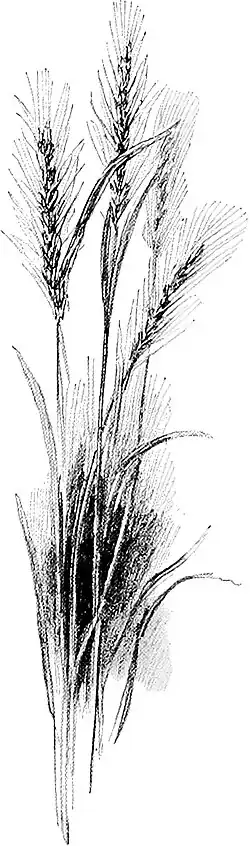
Tickle-grass, or wild rye.But far in the heart of the great weed patch there is a rich growth of goldenrod, and this, unsullied by the name of weed, is dearest of all the blossoms in the Little Girl‘s eyes. This she never plucks, but often, from my window, I see her bend over and press its sprays
to her cheeks, Here big brothers have never penetrated, even in their wildest games of hide-and-go-seek; only the Little Girl, seeing with finer eyes, knows the heart of gold in the refuse. And so an interest, subtle and strange as the fragrance of the goldenrod, hangs
over the Little Girl and her treasures.
Mabel Fletcher (age 16).
Weeds in the West.
Richmond, Kan.