Page:St. Nicholas (serial) (IA stnicholasserial321dodg).pdf/110

Feathers of wounded doves.
Waycross, Ga.
Dear St. Nicholas: Will you tell me why doves shed their feathers when wounded?
Robert Murphy (age 13).
Doves or pigeons do not shed their plumage when wounded. The feathers cut by the shot, and those in the injured skin (not very strongly attached) near the wound, would of course drop out; hence the incorrect belief, common in many places, on which your question is based.
Upper and lower sides of a leaf.
West Sutton, Mass.
Dear St. Nicholas: Please tell me why a leaf is of lighter color on the under than on the upper side. I have noticed this especially on grape-leaves.
Alice R. Knowles.
If a leaf, especially one thin and somewhat translucent, is examined by the aid of a compound microscope, it will be seen that the green pulp has the appearance somewhat of a honeycomb. Ihere is an immense number of cells, some in rows and some irregularly arranged. A few of these cells are colorless and others contain more or less of the green coloring matter of the plant formed by the action of sunlight, Botanists call this green matter chlorophyl. The cells on the upper part of the leaf that are especially exposed to sunlight are well filled with chlorophyl, and are long and narrow, packed side by side closely together. These are called “palisade” cells.
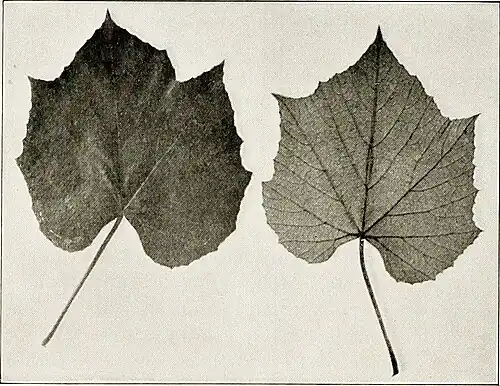
A leaf of the grape-vine.
The lower green cells do not contain so much coloring matter, differ from one another in shape and size, and are laid together loosely, often with very minute air-spaces between them. This makes the under side of the leaf a lighter shade of green. Sometimes the light may be so reflected from these air-spaces as to give the leaf even a silvery or grayish appearance.
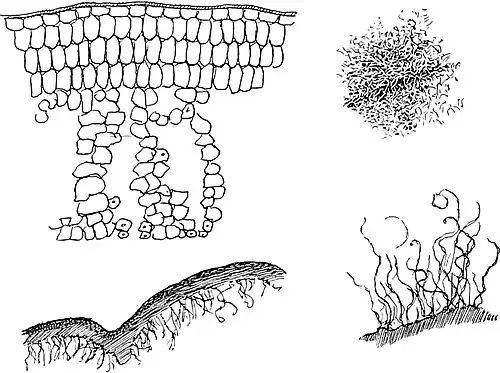
Sections of a leaf
A “lizard” in the ground.
Cambridge, Mass.
Dear St. Nicholas: Last August I found a curious thing up in Chocorus, New Hampshire. I was with some men who were digging a ditch behind our house, when they found a lizard about two feet below the surface. It was about six inches long, and was green, It crawled a little; but they killed it, thinking it must he poisonous. Could you tell me what it was?
Your interested reader,
Minton M. Warren.
This was probably our common newt of an olive-brownish color, going through some underground spring. I know of no animal of that size and lizard-shaped that would be likely to burrow as much as two feet in the ground.