Page:St. Nicholas (serial) (IA stnicholasserial321dodg).pdf/107
on the English and New England coasts. It reaches a maximum length of fifty feet, and is exceeded in size by only three or four animals now alive. Provided with small teeth, it feeds on fishes and floating crustaceans, and is not of a ferocious disposition. It is dangerous only because of its great bulk, and when attacked its powerful tail easily demolishes small boats. The basking-shark was formerly hunted on the coasts of Norway and Ireland for its oil; it was also sought on the shores of Massachusetts in the early part of the last century; and many of these sharks from twenty-five to thirty-eight feet long were recorded. The liver of a large specimen sometimes yielded twelve barrels of oil.
The largest of all fishes, the largest of all cold-blooded animals, and the largest of all existing animals, except a few kinds of whales, is the whale-shark (Rhineodon typicus), originally discovered at the Cape of Good Hope, but now known in Japan, India, South America, Panama, California, and elsewhere, a specimen having recently been obtained in Florida. This shark is said to attain a length of seventy feet, and is known to exceed fifty feet.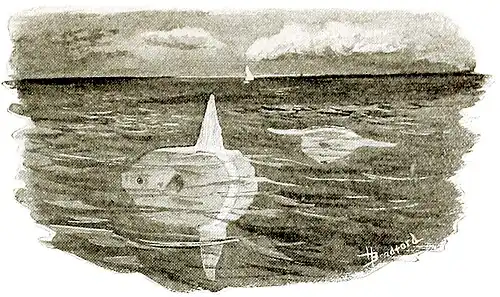
Ocean Sunfish sunning themselves.
(They are about eight feet long when full-grown.)
A fish of such peculiar form that the Italians call it mota (millstone), and the Spaniards pez luna (moonfish), is known to Americans and English as the sunfish, for it appears at the surface of the ocean on bright days and spends many hours basking listlessly in the sun, sometimes lying flat with one side out of the water, sometimes with the back fin projecting like a buoy above the surface. The fish is disk-shaped, its height nearly equaling its length. It is one of the most grotesque of fishes, being apparently nearly all head. Of almost world-wide distribution, it is particularly abundant on the southeastern coast of the United States and on the California coast. It swims but little, being usually content to be drifted along by the ocean currents, The Gulf Stream wafts many a sunfish north each summer, so that the species is not rare off southern New England. That the fish deserves a place on the list of giant fishes may be judged from the fact that examples weighing from two hundred to five hundred pounds are not rare, and that much larger ones are occasionally met with. The weight of the largest known specimen, caught in 1893, at Redondo Beach, California, was eighteen hundred pounds. On such a monster, lying on its side, there would be room for thirty men to stand.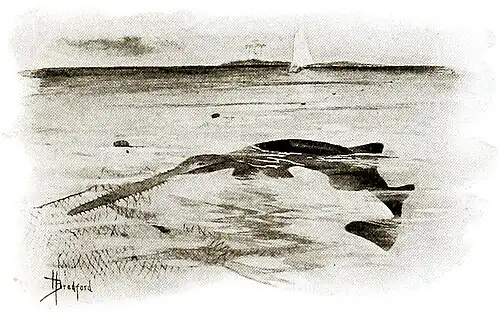
A Sawfish entangled in a net.
(This fish is about twenty feet long when full-grown.)