Page:Somerville Mechanism of the heavens.djvu/224
is of the same order. If then equation (77), be multiplied by dr its integral will be

285. Since this equation has been integrated with regard to r only, λ must be a function of θ, w, and t, independent of r, according to the theory of partial equations. And as the function in r is of the order it may be omitted; and then

,
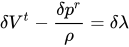
by which equation (70) becomes 7280 {( deu - 2n sin cos 0 + r'dw {sin' 0 ( div du +2n sin 0 cos 0 = dr. dľ dt 286. But as does not contain r, s, or y, it is independent of the depth of the particle; hence this equation is the same for a particle at the surface, or in its neighbourhood, consequently it must coincide with equation (76); and therefore ♪λ = SV' — gsy. - 287. Thus it appears, that the whole theory of the tides would be determined if integrals of the equations r980 d'u dľ -). - 2n sin 0 cos e of do dt du (d)} = gdy + 8V1 y = - d(qu) de d(yr) Yu cos 6 - - + r³ow {sin³ o (de) + 2" sin cos 0 dw sin. could be found, for the horizontal flow might be obtained from the first, by making the co-efficients of the independent quantities 8o, dw, separately zero, then the height to which they rise would be found from the second. This has not yet been done, as none of the known methods of analysis have hitherto succeeded. 288. These equations have been formed on the hypothesis of the earth being entirely covered by the sea; hence the integrals, if they