Page:Sewell Indian chronography.pdf/76
| G. Śōdhya in K.Y. 0 (by Dr. Schram) | 2.171973 days. |
| (2 d. 4 h. 7 m. 38.47 s.) | |
| H. F × 60, or cycle-difference | 254.305802640 days. |
| I. E − H, or additive difference for beginnings of successive cycles | 110.952634860 days. |
| Jupiter's place at the epoch of the Kaliyuga era, i.e. at mean Mēsha saṁkrānti of K.Y. 0 | 359° 27′ 36″ |
167. We have found that 27 Vijaya began 8 d. 16 h. 5 m. 17 s., or 8.67033 d., after apparent solar Mēsha saṁkrānti at K.Y. 0. To find when No. 1 Prabhava of the next cycle began we must add this amount to .
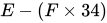
| 365.258437500 | |
| − | 144.106621496 |
| 221.151816004 | |
| + | 8.67033 |
| 229.822146004 |


Therefore, in K.Y. 33 expired (3069-8 B.C.) No. 1 Prabhava began 229.8221 days after apparent solar Mēsha saṁkrānti. This, plus 52 times the value of I and minus a multiple of E, or , gives us the number of days after apparent solar Mēsha saṁkrānti by which No. 1 Prabhava began in K.Y. 3117 expired, i.e., in A.D. 16, since 52 cycles had elapsed by then.

| 5769.537012720 | |
| + | 229.822146004 |
| 5999.359158724 | |
| − | 5844.135000000 |
| 155.224158724 |

Table XXXI. states this as 155.2242, and continues the series for the beginnings of subsequent cycles; Table XXXI.A corresponds to Table XXVII.A, but is for the Brāhma Siddhānta and Siddhānta Śirōmaṇi.
167A. Calculation by Tables XXXI. and XXXI.A (when these alone are used) enables us to ascertain the currency of the saṁvatsara in relation to the solar year; but we cannot fix in European time the moment of beginning or ending of each saṁvatsara unless we know, according to the Brāhma Siddhānta and Siddhānta Śirōmaṇi, the moment of occurrence of apparent or mean Mēsha saṁkrānti of the year in question. This is not given in Table I. of the Indian Calendar nor in any Table as yet, to my knowledge, published, but it can be found by use of the following Table. I must first explain its principles.
The Brāhma Siddhānta and Siddhānta Śirōmaṇi, equally with the First Ārya Siddhānta or Āryabhaṭīya, recognise the sunrise epoch of the Kaliyuga, viz., mean sunrise on Friday, February 18th, Deducting 3102 B.C., or February 18th, 0 h. 0 m. 0 s., placing mean Mēsha saṁkrānti at that moment.[1] Deducting the śōdhya interval as fixed by Dr. Schram for the two former authorities, viz., 2 d. 4 h. 7 m. 38+1/2 s., we have, for true Mēsha saṁkrānti according to them, February 15th at 19 h. 52 m. 21+1/2 s.; and deducting the śōdhya interval as fixed in the Indian Calendar for the latter authority, viz., 2 d. 3 h. 32 m. 30 s., we have for true Mēsha saṁkrānti by the First Ārya Siddhānta February 15th at 20 h. 27 m. 30 s.
Now the solar year by the First Ārya is (see Table XXXVII.) 21 s. longer than that by the Brāhma Siddhānta and Siddhānta Śirōmaṇi, and consequently there was never a year in which the
- ↑ They have not a general conjunction at K.Y. 0; their general conjunction of the planetary bodies was at sunrise at the beginning of the Kalpa, and they begin their calculations from that moment. [Note given by Dr. Fleet.]