Page:Sewell Indian chronography.pdf/72
moment of mean Mēsha saṁkrānti of K.Y. 1 current, the epoch of the Kaliyuga.[1] Then will give us the beginning moment of the No. 1 Prabhava of the next cycle.
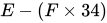
| Civil days. | |
| 365.258750000 | |
| −143.889202818 | |
| 221.369547182 | |
| + 2.1476 | |
| 223.3823 |


Hence we have it that No. 1 Prabhava began, in K.Y. 33, or 3069–68 B.C., 221.36955 days after mean Mēsha saṁkrānti, and Table XXX. starts from that point. I have made the calculations with nine places of decimals, but tabulate only with four places for convenience. The process is fully explained in the working for the Present Sūrya Siddhānta, §§ 141–146 above.
| Civil days. | |
| 5789.504623760 | |
| +143.889202818 | |
| 6010.874170942 | |
| − 5844.140000000 | |
| 166.734170942 |


The beginning of Prabhava in K.Y. 3117 (A.D. 16–17) therefore took place 166.7342 days after mean Mēsha saṁkrānti. Table XXX. states this figure and continues the figures for the beginnings of all subsequent Prabhavas.
161. Table XXX.A corresponds to Tables XXVII.A, XXVIII.A, XXIXA., but is for use in calculations by the Original Sūrya Siddhānta.
162. Calculation by these Tables enables the currency at mean Mēsha saṁkrānti, according to the Original Sūrya Siddhānta, of the Jovian saṁvatsara to be correctly ascertained; but no Tables hitherto published enable us to fix for each solar year the time of occurrence of mean Mēsha saṁkrānti by that authority, and without such we cannot fix the times of beginning and ending of such a saṁvatsara. I have therefore prepared the accompanying Table, to enable this to be done, on the following principles.
The First Ārya Siddhānta[2] starts its calculations from mean sunrise on Friday, February 18th,
- ↑ In accordance with what I believe to be the usual Hindū practice, as explained in "Hints," No. 18, I assume that, the two moments exactly coinciding, Vijaya's beginning was theoretically taken as occurring immediately after the mathematical point of mean Mēsha saṁkrānti, so that, ending before the end of the solar year, Vijaya was expunged. It was considered to begin and end within the limits of one solar year.
- ↑ Dr. Fleet kindly helped me in this matter, and calculated the moment of coincidence thus:—
First Ārya Siddhānta. Sunrise epoch of the K.Y. in elapsed days of Julian period, at mean sunrise, February 18th, 3102 B.C 588,466.00 1 year 365.258680555̇ × 3600 1,314,931.249̇…… 1,314,931.25 1,903,397.25 0 March, A.D. 499 1,903,376.00 21.25 Original Sūrya Siddhānta. Midnight epoch of the K.Y in elapsed days of Julian period, at previous midnight 588,465.75 1 year 365.25875 × 3600 1,314,931.50 1,314,931.50 1,903,397.25 0 March, A.D. 499 1,903,376.00 21.25 Mean Mēsha saṁkrānti, therefore, took place by both authorities at 0.25, i.e., 6 hours after mean sunrise, that is at noon, on Sunday, March 21st, A. D. 499. 1,903,397 ÷ 7 gives remainder 6 = Sunday. (See note, p. 62 below.)