Page:Sewell Indian chronography.pdf/33
At the instant of true Mēsha saṁkrānti the mean longitude of the sun is . Let the mean longitude of the sun's apsis at this instant be called . Then we have—


(ii.) ,

.

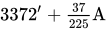
To obtain the sine of we use the Table of Hindū Sines published in E. Burgess's "Sūrya Siddhānta," p. 285, and in the "Journal of the American Oriental Society," Vol. VI., p. 197, where the sine is expressed in minutes. Since at the instant of Mēsha saṁkrānti the angle is, according to all the Siddhāntas, contained within the limits of 78° 45′ and 82° 30′, we have—[1]

(iii.) .

We now calculate this for the First Ārya Siddhānta (the Āryabhaṭīya). According to Jacobi (Epig. Ind. I., p. 441), the sun's equation of the centre is—
(iv.) .
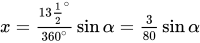
Substituting in (iv.) the value of from (iii.) we have—

,

and from this equation—
(v.) ,

or .

According to this Ārya Siddhānta there are in a yuga 4,320,000 revolutions of the sun and 1,577,917,500 civil days; and therefore the mean daily motion in minutes is—
(vi.) and .
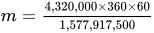

or .

As according to this Ārya Siddhānta the longitude of the sun's apsis is always 78°, we have , or .


Putting in this value respectively in (v.) and (vi.) we have always—
(viii.) Sun's equation at true Mēsha saṁkrānti = 2° 6.9553916′; and śōdhya, in days, = 2.14683143, or shortly, 2.146831 d.
On this principle Dr. Schram has calculated for the other Siddhāntas concerned.
39F. By his other method of approximations he took the data from the recognized authorities, e.g., the sun's anomaly from Jacobi's Epigraphia Indica (Vol. I.) Tables, as well as the sun's mean daily motion (ibid., p. 442); the sun's true daily motion at the moment of Mēsha saṁkrānti from Warren's Kala Sankalita, Table XXVIII.; the equation of the sun's centre from Jacobi (op. cit., p. 441); and the sun's mean longitude for the instant when his true longitude is 0° (viz., 337° 51′ 38″) from Jacobi's Table XX. Taking this last as his first approximation for the sun's mean longitude at mean Mēsha saṁkrānti, he finds the anomaly from this mean longitude minus the longitude of the apsis (78°), and thence obtains the value of . Having worked out three separate, and each closer, approximations, he obtained for final result the same figure as given above for the śōdhya, viz., 2.146831 d. He then proved this result by Jacobi's Table XXIV.
Dr. Schram's calculation for the Sūrya Siddhānta was complicated by the fact that it contains a quadratic term. The sun's equation of the centre is (Jacobi, Epig. Ind. I., 441)[2] . This formula being substituted in (iii.) above gives the starting point for

- ↑ The quoted Table of sines tabulates, for an angle of 78° 45′, 3372′, and the next angle dealt with is 82° 30′. The difference between the sine of the first and the sine of the second angle is 37′. As the difference between the angles is 225′ the difference for each minute is 37/225. Therefore, if the angle to be dealt with is, as here, greater than 78° 45′—if, that is, we are dealing with an angle —the sine of that angle is . Hence formula (iii.).
- ↑ There is a misprint in Prof. Jacobi's paper on p. 441, l. 18, where he gives the equation of the sun's centre for anomaly as &c. The whole should be .