Page:Sewell Indian chronography.pdf/100
is + 33 m. 18 s. Total, 1 h. 22 m. 18 s. Adding this to 7 h. 52 m. 30 s., we have 9 h. 14 m. 48 s.; or 9 h. 15 m. on the same day (as we have already found to be the time of mean M.S. by the Sūrya Siddhānta in Example 6 (b) ).
Example 8.—The reverse process.
Rule. Apply the corrections as in the last example, but with reversed signs.
This is merely the converse of the last, and requires no working.
Example 9.—To find, according to the Ārya Siddhānta, the time of tropical Mēsha saṁkrānti in any year.
Rule. This is given on pp. 152–3 of the Indian Calendar, and the process is explained above (Tropical saṁkrāntis, § 33, &c.).
Wanted the time of occurrence according to the Ārya Siddhānta of the tropical (sāyana) Mēsha saṁkrānti of Śaka 1000 current, K.Y. 4179 current, A.D. 1077–78.
I take the year for which the process was shown in the Indian Calendar because its accuracy within one minute has been fully established. According to the Ārya Siddhānta the base-year is Śaka 445. We find the time of tropical Mēsha saṁkrānti in the same way as all other tropical saṁkrāntis, and, for this, Table I. gives us our starting point. The time of true sidereal Mēsha saṁkrānti in the given year was March 23rd at 14 h. 52 m.
(a) Rough calculation. (The given year, Śaka) 1000 − 445 (the base-year) = 555, and 555 ghaṭikās = 9 d. 15 gh., or (Table XXV.) 9 d. 6 h. Deducting 9 d. 6 h. from March 23rd., 14 h. 52 m., we have March 14th 8 h. 52 m., and this was roughly the time of tropical Mēsha saṁkrānti in the given year.
(b, i.) Accurate calculation. We note that since the tropical was earlier than the sidereal Mēsha saṁkrānti by about 9 days, those days belonged to sidereal (nirayaṇa) Mīna,[1] and that the length of Mīna (Table XVIII.A, col. 7) is 30 d. 8 h. 7 m. 42 s. The difference of years gives us (as above) 555 gh., or, multiplied by 1/60 = 9+15/60, or 9° 15′ in ayanāṁśas (degrees of precession), or 9+1/4°.

We ignore seconds less than half a minute.
| h. | m. | ||
| True sidereal Mēsha saṁkrānti | March 23 | 14 | 52 |
| − 9 | 8 | 30 | |
| Tropical M.S. | March 14 | 6 | 22 |
Answer. Tropical Mēsha saṁkrānti of Ś. 1000 occurred, according to the Ārya Siddhānta, on March 14th at 6 h. 22 m. after sunrise.
(b, ii.) In Table XX.A I have attempted to simplify the above process. The figures in col. 2 of that Table give, for each sidereal month, the length of the month divided by 30, or the time occupied by the sun in travelling 1°; so that instead of the element of calculation (for Mīna)—
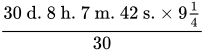
we may substitute (Table XX.A, col. 2, for Mīna) 1 d. 0h. 16 m. 15.4 s. × 9+1/4, which = 9 d. 8 h. 30 m. 22 s., i.e., gives the same result as in b (i.).
(b, iii.) Or, again, those who prefer it may still further simplify the sum by taking the equivalent in decimals of 1/30th of the month Mina, viz., 1.0113 d. (if only four places of decimals are used), as given in the same Table, and multiplying it by 9+1/4°, or 9.25. This results in 9.354525, which, taken as days, = 9 d. 8 h. 30 m. 31 s. (Table XXXVI.) Such is the result working with only four places of decimals.
- ↑ See note following Example 18b.