Page:Sewell Dikshit The Indian Calendar (1896) proc.djvu/264
.

The angle being, at the moment of greatest phase, always sufficiently near 90° or 270", can be neglected; and, introducing for its mean value 27,544, and identifying , with , the value of can simply be determined by the expression instead of determining it by the whole of the above formulæ. Now in this last expression and are mere dependents on , and therefore the values of can be tabulated for each value of with the two arguments and . Table D is constructed on this formula, only instead of counting in degrees and from true noon it is counted, for Indian purposes, in ghaṭikâs and their tenths from true sunrise.





The value of for the instant of the greatest phase at the given place being found, it can be introduced into the formula .

As is always near 90° or 270°, can be considered equal to ±1, so we have where the sign ± is to be selected so that the value of may always be positive.



The second part of the above expression (which, for the sake of brevity, may be called by the letter ) contains only values which directly depend on , such as , , , or which, for a given value of , depend only on and , and therefore the values of can be tabulated for each value of with the two arguments and . This has been done in the Table B which follows, but instead of the value has been tabulated to avoid negative numbers. The value of can then be found from .



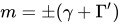
Both Tables B and D ought to consist of two separate tables, one containing the values of from 0° to 360° in the case of being near 0°, the other containing the values of from 0° to 360° for the case of being near 180°. To avoid this division into two tables, and the trouble of having always to remember whether is near 0° or 180°, the two tables are combined into one single one; but, whilst in the case of being near 0° is given as argument, in the case of being near 180° the table contains, instead of , as argument. We need therefore no longer care whether the moon is in the ascending or descending node, but simply take the argument as given in the first table. With the value of , found by , we can find the magnitude of the greatest phase in digits , which formula can also be tabulated with the arguments , and , or with and . This has been done in Table C. As when abbreviated to two places of decimals has only the six values 0.53, 0.54, 0.55, 0.56, 0.57 and 0.58, every column of this Table is calculated for another value of , whilst to the constant 5 has been added so that all values in the first Table may be positive. Instead of giving , directly, its last cipher is given as tenths to the value of so that there is no need for ascertaining the value of .


Of all elements, then, given by the Canon we want only the following ones;—
| Date of eclipse, and Greenwich mean time of conjunction in longitude. |