sition. Without great strength, with his 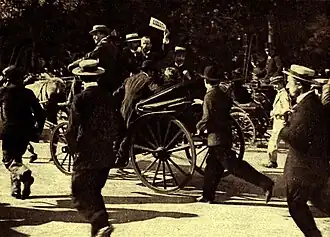
Socialists hooting Catholics who are displaying the motto “Liberté” as a protest against the expulsion of orders.whole political creed a belief in compromise which should not give up the essentials of power, and in diplomacy which should play off one warring element against another, and leave the throne unharmed, he has found success beset by many difficulties. Had he not possessed a personality which has strongly attached to him the great
majority of his turbulent subjects, it is hard
to see how he could have succeeded at all.
The average American hardly appreciates the political significance of the Empire of Austria-Hungary, nor the vast importance of the situation there to the future of Europe. Government there is more a display of hysterical sentiment than a political organization for national, industrial, and commercial advancement. It is not easy for us, with our assimilative power of turning all nationalities into Americans, to comprehend the intensities of the racial antagonisms of Europe. Nowhere do these antagonisms find freer play than in Austria-Hungary. The Poles and Bohemians retain memories of a past political greatness. The Magyars have as keen a pride of race as any living people. Every one of the dozen nationalities of the empire has racial ambitions of its own, an almost fanatical determination to exalt this language or that, and a total disregard for the general welfare in the struggle of many tongues and various racial ideals.
It seems absolutely hopeless to expect that the Austria-Hungarian Empire will eventually constitute itself into a confederacy after the German model—compact, homogeneous, centralized. If one looks for such agreement as affording the only political bands that can permanently bind Austria together, it is easy to conclude that dissolution, dismemberment, and partitioning must be written into her future, or to believe, as some do, that the future of the dual empire can be compassed in a sentence—that it is to be a new Balkan with a dozen little nations all at war, and in their racial prejudices that touch of fanaticism which will make them irreconcilable enemies. There are numberless reasons which can be brought forward pointing to the end of the Hapsburg reign; but unpromising and complicated as the situation is, there is one impressive reason stronger than all those that point to dissolution, one reason why the empire will go on even after Franz Joseph's death and the coming of a far less politic ruler: No European nation is anxious for Austria’s territory.
In spite of all the ambition with which Germany is credited, the weight of opinion in Germany is unfavorable to any extension of territory at Austria’s expense. There are reasons enough apparent why Hungary, with its racial prejudices, its own national ambition, and the certainty of its forming a new Reichstag party, should not be brought into the empire. There are reasons almost as potent why the German provinces of Austria would not be welcome. It is true those provinces are thoroughly German in language, sentiment, thought and aspiration. Their folk songs and poetry are full of longing for union with the Fatherland, but there is no sentiment among the influential people of Germany which would tend toward taking these provinces into the empire, bringing, as they would, a great