istic doctorines. They have come to be notably mild and there has been eliminated so much of what was the old school of collective socialism that the party seems hardly entitled to the name of Socialist.
The great wave of Socialism which has swept over Germany is really only a wave of liberalism: the foundations of the Government are in nowise shaken by it. Most of the demands which the triumphant Socialist party make are of a character which will tend toward increased industrial efficiency should the Socialist go on toward even greater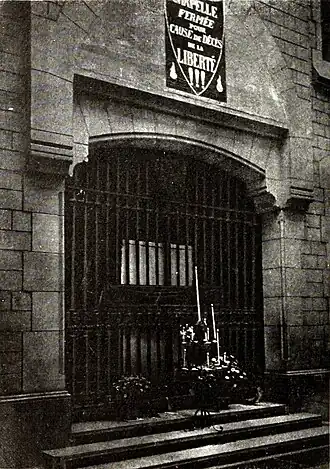
The Church of the Carmelite Monks in Paris closed by the police. success.
Germany, then. I believe, is a field which we should watch with the most intense interest for the evolution in political life which is sure to come, but that evolution has in it only promise of stronger and better government, and no sign of anything that threatens the Government’s permanence. There is much which we might well envy in the practical accomplishments of the German Government in the aid it gives to industry and the effect it has on commercial life: in the thoroughness and honesty of administration, and in the substantial benefits received by every citizen. Whatever there is of evolutionary change in the future promises more, not less, efficient aid to industry. Whatever modifications are worked out in the national life—and there may be many—promise to result in giving Germany better government, and in furnishing a more secure foundation for the upbuilding of her industrial life, developing her as a competitor and strengthening her as a rival.
Beyond all question America’s greatest industrial competitor is Germany: the development in political life there promises no reactionary tendency in respect to industrial efficiency. Great as Germany is today as an industrial competitor, the coming years will make her greater.
Although we may find in France and Germany a preponderance of reasons pointing to political stability, what of Austria-Hungary? Is the political life of the dual monarchy near its end? Is there to be dismemberment, with all the endless consequences to European politics which a partitioning of the empire would engender? Any amount of support can be found for the most pessimistic views In regard to Austria’s political future. Statesmen and journalists have not hesitated to write most frankly of their belief that great changes are impending there. Diplomats of experience may be found who hold the opinion that the funeral bells of Franz Joseph will ring down the curtain on the last act of the Hapsburg sway, and that will be true in spite of the age of the empire, the strength of tradition, and the convulsion which the whole political fabric of Europe will undergo.
Certain it is that Austria-Hungary in its potentiality for political change is the most interesting country in Europe. The empire, with its peculiar duality of emperor and king, its two capitals, its triple ministry, its six chambers, its eighteen parliaments, and its dozen nationalities, offers a conglomeration of political ideas and ideals of racial antagonism and of parliamentary inconsistencies which have strained to the utmost the diplomacy of the beloved monarch. Franz Joseph has in many ways ideally managed the difficulties of his po-