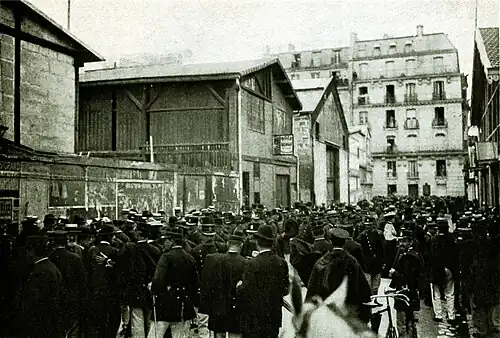
The police surrounding a parochial school in the Ternes quarter preparatory to turning out the occupants.
of the people small influence. Without a doubt the German governmental organization is the best bureaucracy, the most scrupulously honest, and, within its lights, the most painstaking and hard-working, that any government has trained to its aid; but the results are not popular government. The seeds of a desire for popular government were long ago sown in Germany, It is an expression of that desire, it is the political determination of the common people to write “truth” into the constitution, that gave the Social Democratic party in the last election three million votes—just under a third of the total. But the tremendous growth and the sweeping victories of that party are not to be taken as showing a disposition on the part of the German voter violently to overthrow existing conditions. They are critical of the growing expenditures of the Government, particularly for the navy, and they resent the injustice of the arrangement of the constituencies under which there is the greatest inequality of representation in the Reichstag. They are a party of protest against many existing conditions, but they do not threaten the permanency of Government; and as they are sobered by increasing power and responsibility, their programme becomes in the main one which the average American voter would regard as an enunciation of fundamental principles of political equality and good government.
The point of view of the Social Democrats is mainly economic. They believe that the present economic development—a development nowhere better illustrated than in Germany—makes necessary new political conditions. They see in that development influences leading inevitably to the greater and greater substitution of machinery for hand employment, to the stifling of small industries by great combinations. They believe that it has a tendency to place the means of production within the exclusive control of a comparatively small number of people, and they hold that this small group has monopolized more than its share of those advantages brought about by the increase in productive capacity. They are thus led to believe that this whole economic development makes necessary a revision of settled convictions both in regard to capital and the influence of the state on economic life. They hold in general that the authority of capital must be narrowed, while the limits and rights of the state to exercise control in economic affairs must be enlarged. So much for their strictly social-9