onism toward this industrial development. This new industry has successfully competed with the meagre wage the landowner was able to offer to the farm hand. Bleak cottages are left empty, and fields are robbed of labor. The landlords late servants, over whom he ruled almost as ruled his feudal ancestors, have not only left his acres, but in the cities they have organized themselves into a political power and shout “bread usurer™ at him, and in their determined demands for cheap food, keep up a constant warfare 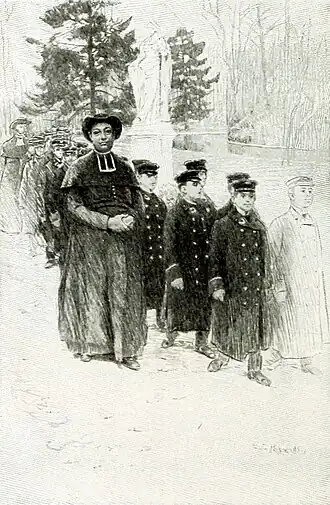
School boys walking with a priest.upon that protective tariff that is the only barrier the junker has left between his land and financial ruin.
All that is bad enough; but when this same industrialism which has touched the aristocrat in his purse wounds him also in his pride, when it builds up a new aristocracy, a new ruling class with strength and position measured by wealth, and begins successfully to assail the junker’s immemorial influence in national affairs, the bitterness of his position, with his traditions of fortune and power thus being undermined, is not hard to understand.
So Germany has, in the irreconcilable differences between agriculture and industry, an “irrepressible conflict™: On the one hand a landed aristocracy lone used to political power—a power whose roots run back to feudal tradition, but whose very daily life is now hampered and made difficult by depression in agriculture; while opposed to this aristocracy of birth is a flauntingly prosperous industrialism, with its rebellion against class, its demand for the curtailment of the privileges of the nobles, its appeal for broader political rights, and more secure individual liberty. The struggle which will go on between these irreconcilable elements of the German nation must have in it constant interest for us, and an interest that is not merely academic, for the progress of the conflict will have intimate relation to our position In international trade.
When one gets even slightly below the surface in a study of political conditions in Germany, he cannot fail to be surprised that so little has been accomplished in the direction of political equality and freedom. The junker’s influence has its roots in centuries of prerogative. In a generation Germany has become a great power, political and economic, but in that time there has been no material internal advance in the direction of freedom. Constitutional Government is a semblance and a pretence, not a reality. The Reichstag at first had little enough influence in shaping legislation, compelled as it was to work with a ministry in nowise responsible to it and dependent for its life only on royal favor: but instead of gaining for itself that decisive power which the popular house should have in a really representative government, its actual authority has substantially diminished. It has relinquished much of its control over expenditures, and has also limited its power over income by agreeing to an arrangement for a rigid and intricate system of taxation which in its detail has no flexibility even to the wishes of the majority.
Germany is governed by a bureaucracy, and in many ways better governed than any other nation in the world. Popular representation has little existence, and the voice