But the real reason why France may today be set down as among the most pacific of nations lies in this foot France is not so much a republic, not so much a government administered Hy the voice of the people, as it is an oligarchy. The Government of France is really a government by a political dynasty, by a group of men and their political heirs, who have made a business of governing France, and, having left to them the centralized instrument of the 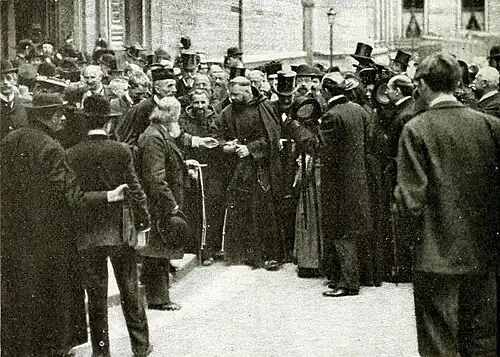
Monks of the Capuchin order greeted by their friends after being fined by the Conventional tribunal for refusing to give up life in common. Napoleonic system, have governed France,
not particularly as a majority vote of the nation might have dictated, but as they have best seen fit-with some patriotism for France, and with much regard for their own place, power, and perquisites. This political dynasty has no disposition to risk anything on war, for war would mean
one of two things. If it ended in defeat, it would mean that the French nation would rise up, as it always has risen when its sensibilities were really smitten, and the whole dynasty would be irrevocably tumbled out of office, to say nothing of the prospect of upsetting the form of government itself. But a military victory to France would have in it quite as distressing possibilities for her political dynasty as would a military defeat; for a military victory would mean a military hero, and France can never be trusted not to lose her heart to a military hero. So sharply is this always in the mind of the Government that when the nations had a bit of police work to do at Pekin, and under hardly any conceivable development could thereby garner many military laurels, the man who, by every right of precedence, position, and ability, should have gone in to the far East at the head of the French troops was kept at home, and a man was selected with abilities of a type that left no fear in the mind of the Government about his ever becoming a military idol.
France may give us occasional exhibitions of political turmoil. It is not improbable that the socialistic sentiment in France will continue to grow, and that there will he some evolutionary changes in government; but I believe that the solidity of the republic may be set down as one of the practical certainties of European politics, and that so far as the future of France, as a world-industrial competitor is concerned, we may count upon her industries being developed without serious interference from any political change.
If we turn to Germany we find there on the face of things much that might indicate impending radical political change. There is certainly political progress there—progress toward individual liberty and political equality, progress toward really representative government. If one were to try to put into a single phrase the significance of the political currents and tendencies, the real essence of the vital political life of Germany, it could well be said that it is to write “truth” into the constitution. Germany’s constitution contains many fair-sounding provisions for liberty and equality, but it has not, in fact, furnished either liberty or equality to the humble German citizen. The constitution says that every man shall have equal justice, that every man shall be eligible to public office, and that there shall he fairness of franchise and of voting representation. In the practical operation of government none of those guarantees is fully kept.