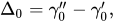
UNPUBLISHED FRAGMENTS.
433

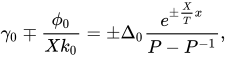
The condition of no electrical current gives

Apply to both ends and add,
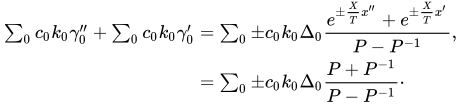
If we set, to abridge,

When the summations are for cations or anions separately, the last equation may be written

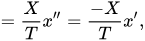
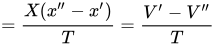
which gives
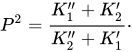
| Now |
 |
 |
|
 |
|
|
|
|
 |
 |
|
 |

|
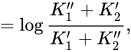
 is the part of the conductivity of the first electrolyte which is due to the cations.
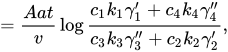
If the first electrolyte contains only one cation (1) and one anion (2), and the second only one cation (3) and one anion (4), we have
|
|
|
| or, since |
 |

|
|
|

|
like the formula which you quote.