UNPUBLISHED FRAGMENTS.
431
Integrating from one point to another in the electrolyte,

The evaluation of these integrals which denote the resistance and electromotive force for a finite part of the electrolyte depends on the distribution of the ions in the cell. For one salt with varying concentration,

or, since  and
and  ,
,


The resistance depends on the concentration throughout the part of the cell considered, but the electromotive force depends only on the concentration at the terminal points ( and
and  ).
).
For  and
and  we may write
  and
and  , where
  and
and  are the "valencies" of the molecules. This gives
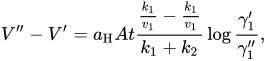
for

(circuit open).
I think this is identical with your equation ( ) when your ions have the same valency.
Planck's problem is less simple.[1] We may regard it as relating to a tube connecting the two great reservoirs filled with different electrolytes of same concentration, i.e.,  . I use (0) for an y ion, (1) for any cation, (2) for any anion. [The accents () and () refer to the two reservoirs.]
The tube is supposed to have reached a stationary state and dissociation is complete. The number of ions is immaterial, but they all must have the same valency  .
.
Now by equations (3) and (4), since  ,
,

- ↑ [Planck, Wied. Ann., vol. xl (1890), p. 561.]