280
EQUILIBRIUM OF HETEROGENEOUS SUBSTANCES.
in which  are determined by the function mentioned, and
  , by the component of the motion of
  which lies in the plane of the surface.
With this understanding, which is also to apply to  and
and  when contained implicitly in any expression, we shall proceed to the reduction of the condition (606).
With respect to any one of the volumes into which the system is divided by the surfaces of discontinuity, we may write

But it is evident that
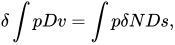
where the second integral relates to the surfaces of discontinuity bounding the volume considered, and  denotes the normal component of the motion of an element of the surface, measured outward. Hence,

Since this equation is true of each separate volume into which the system is divided, we may write for the whole system

(609)
where  and
and  denote the pressures on opposite sides of the element , and is measured toward the side specified by double accents.
Again, for each of the surfaces of discontinuity, taken separately,

and

where  and
and  denote the principal curvatures of the surface (positive, when the centers are on the side opposite to that toward which is measured),
  an element of the perimeter of the surface, and
  the component of the motion of this element which lies in the plane of the surface and is perpendicular to the perimeter (positive, when it extends the surface). Hence we have for the whole system

(610)
where the integration of the elements Dl extends to all the lines in which the surfaces of discontinuity meet, and the symbol  denotes a summation with respect to the several surfaces which meet in such a line.
By equations (609) and (610), the general condition of mechanical equilibrium is reduced to the form
