214
EQUILIBRIUM OF HETEROGENEOUS SUBSTANCES.
Moreover, since  must vanish in (452) when
  , we have

(456)
From the three last equations may be obtained the values of  in terms of
  , and
, and  ; viz.,

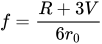
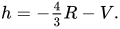
(457)
The quantity  , like and
  , is a function of the temperature, the differential coefficient
  representing the rate of linear expansion of the solid when without stress.
It will not be necessary to discuss equation (443) at length, as the case is entirely analogous to that which has just been treated. (It must be remembered that  , in the discussion of (443), will take the place everywhere of the temperature in the discussion of (444).) If we denote by
  and
and  the elasticity of volume and the rigidity, both determined under the condition of constant entropy, (i.e., of no transmission of heat,) and for states of vanishing stress, we shall have the equations:—
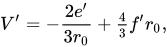
(458)
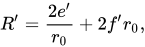
(459)

(460)
Whence

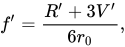
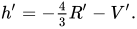
(461)
In these equations  , and are to be regarded as functions of the quantity .
If we wish to change from one state of reference to another (also isotropic), the changes required in the fundamental equation are easily made. If a denotes the length of any line of the solid in the second state of reference divided by its length in the first, it is evident that when we change from the first state of reference to the second the values of the symbols
, and are to be regarded as functions of the quantity .
If we wish to change from one state of reference to another (also isotropic), the changes required in the fundamental equation are easily made. If a denotes the length of any line of the solid in the second state of reference divided by its length in the first, it is evident that when we change from the first state of reference to the second the values of the symbols  are divided by
  , that of
  by
by  , and that of
  by
by  . In making the change of the state of reference, we must therefore substitute in the fundamental equation of the form (444)
  for
for  , and
, and  , respectively. In the fundamental equation of the form (443), we must make the analogous substitutions, and also substitute
  for (It will be remembered that
  , and
, and  represent functions of , and that it is only when their values in terms of are substituted, that equation (443) becomes a fundamental equation.)