198
EQUILIBRIUM OF HETEROGENEOUS SUBTANCES.
reference and in its variable state. (This involves no loss of generality, since we may make the unit of length as small as we choose.) Let the fluid meet the solid on one or both of the surfaces for which  is constant. We may suppose these surfaces to remain perpendicular to the axis of
  in the variable state of the solid, and the edges in which
  and
and  are both constant to remain parallel to the axis of
  . It will be observed that these suppositions only fix the position of the strained body relatively to the co-ordinate axes, and do not in any way limit its state of strain.
It follows from the suppositions which we have made that
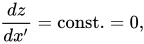
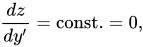
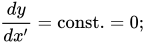
(398)
and


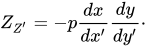
(399)
Hence, by (355),

(400)
Again, by (388),

(401)
Now the suppositions which have been made require that
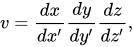
(402)
and

(403)
Combining equations (400), (401), and (403), and observing that  and
and  are equivalent to
  and
and  , we obtain

(404)
The reader will observe that when the solid is subjected on all sides to the uniform normal pressure  , the coefficients of the differentials in the second member of this equation will vanish. For the expression
  represents the projection on the Y-Z plane of a side of the parallelepiped for which
  is constant, and multiplied by it will be equal to the component parallel to the axis of of the total pressure across this side, i.e., it will be equal to
  taken negatively. The case is similar with respect to the coefficient of
  and
and  evidently denotes a force tangential to the surface on which it acts.