192
EQUILIBRIUM OF HETEROGENEOUS SUBSTANCES.
discontinuity by the matter on one side and determined by its state of strain shall be equal and opposite to that exerted by the matter on the other side. Since



we may also write
 |
 (380) (380)
|
| etc.,
|
where the signs of  may be determined by the normal on either side of the surface of discontinuity.
Equation (371) expresses the mechanical condition of equilibrium for a surface where the solid meets a fluid. It involves the separate equations
 |
 (381) (381)
|

|

|
the fraction  denoting the ratio of the areas of the same element of the surface in the strained and unstrained states of the solid. These equations evidently express that the force exerted by the interior of the solid upon an element of its surface, and determined by the strain of the solid, must be normal to the surface and equal (but acting in the opposite direction) to the pressure exerted by the fluid upon the same element of surface.
If we wish to replace  and
and  by
by  and the quantities which express the strain of the element, we may make use of the following considerations. The product
  is the projection of the element on the Y-Z plane. Now since the ratio is independent of the form of the element, we may suppose that it has any convenient form. Let it be bounded by the three surfaces
  ,
,  ,
,  , and let the parts of each of these surfaces included by the two others with the surface of the body be denoted by
  , and
, and  , or by
  , and
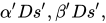
, and  , according as we have reference to the strained or unstrained state of the body. The areas of , and are evidently
  , and
, and  ; and the sum of the projections of , and upon any plane is equal to the projection of upon that plane, since , and with include a solid figure. (In propositions of this kind the sides of surfaces must be distinguished. If the normal to falls outward from the small solid figure, the normals to , and must fall inward, and vice versa.) Now
  is a right-angled triangle of which the perpendicular sides may be called
  and
and  .
.