116
EQUILIBRIUM OF HETEROGENEOUS SUBSTANCES.
Comparing the two methods, we observe that in one

(187)

(188)
and in the other

(189)

(190)
Now  and
and  are evidently determined by the inclination of the tangent plane, and
 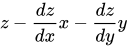 is the segment which it cuts off on the axis of
  . The two methods, therefore, have this reciprocal relation, that the quantities represented in one by the position of a point in a surface are represented in the other by the position of a tangent plane.
The surfaces defined by equations (187) and (189) may be distinguished as the  surface, and the
  surface, of the substance to which they relate.
In the surface a line in which one part of the surface cuts another represents a series of pairs of coexistent states. A point through which pass three different parts of the surface represents a triad of coexistent states. Through such a point will evidently pass the three lines formed by the intersection of these sheets taken two by two. The perpendicular projection of these lines upon the  plane will give the curves which have recently been discussed by Professor J. Thomson.[1] These curves divide the space about the projection of the triple point into six parts which may be distinguished as follows: Let
 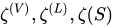 denote the three ordinates determined for the same values of
  and
and  by the three sheets passing through the triple point, then in one of the six spaces

(191)
in the next space, separated from the former by the line for which 

(192)
in the third space, separated from the last by the line for which 

(193)
in the fourth

(194)
in the fifth

(195)
in the sixth

(196)
- ↑ See the Reports of the British Association for 1871 and 1872; and Philosophical Magazine, vol. xlvii. (1874), p. 447.